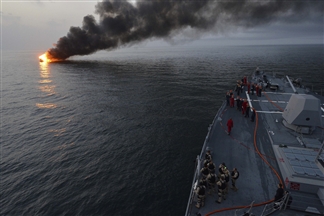
Phot – war.gov Public domain
By Zorina Grey CBNC News
The U.S. naval blockade of Iranian oil has done what years of sanctions paperwork could not, and Tehran is now staging more than 14 tankers at Kharg Island to test whether Washington will hold the line. Satellite imagery and ship-tracking data show crews assigned to the vessels and Iranian flags raised over them, with the convoy expected to move toward the Sea of Oman exit in the coming days.
The strategic objective of the blockade is plain. It is designed to cut off the revenue that funds the Islamic Revolutionary Guard Corps, its missile program, and its proxy network, without committing American ground forces to another open-ended war in the region. The alternative left in place is a cycle of strikes and counterstrikes that spends American lives, American munitions, and American money with no defined end.
Kharg Island is the pressure point. The terminal handles roughly 85 to 90 percent of Iran’s crude exports, can store about 30 million barrels, and has the deep water needed to load supertankers. Loading there has largely stopped since the blockade began, and the backup port at Jask lacks the infrastructure to replace it. Tehran’s treasury has absorbed that loss for weeks, and the convoy is the regime’s admission that it cannot absorb it much longer.
The regime is now probing for gaps. The ship-tracking firm TankerTrackers said its data confirmed Iran was resuming exports, and reports on Thursday described a ship-to-ship transfer of Iranian crude near Kharg with transponders switched off to hide the cargo’s origin. Washington had already said it would target vessels involved in such transfers. On Friday, U.S. Treasury officials met with counterparts from Singapore and Malaysia to warn them of the risks of ignoring American sanctions on Iranian oil.
The threats from Tehran followed on schedule. A journalist tied to the IRGC posted that any move against the tankers would bring explosions at oil facilities in the United Arab Emirates, Saudi Arabia, Qatar, Kuwait, Oman, and Bahrain. Ali Balali, an adviser to the commander of the IRGC aerospace force, said Iran faced no limits on missile numbers, positions, or deployment.
The collectivist claim is that the blockade destabilizes the global energy market and that the so-called international community, not Washington, should set the terms for Iranian oil. That claim fails on capacity and on incentives. The international community has no navy willing to enforce anything in the Persian Gulf, and the buyers of Iranian crude have every reason to keep the oil flowing regardless of what it pays for. Only the United States has the ships and the will to impose a cost on the regime.
The American market has not paid the price the critics predicted. Energy Secretary Chris Wright said on Thursday that energy flows through the Strait of Hormuz have increased and that the United States has been exporting more gasoline, diesel, and jet fuel for several weeks. Gasoline prices at home have fallen even as the standoff continues.
President Trump has said he is not rushing a decision on next steps and that the matter could wait until 2027. U.S. Central Command on Friday denied Iranian media claims of a new American strike on Qeshm Island. The posture is deliberate. Washington holds the blockade, declines the bait, and leaves Tehran to decide whether to spend its last export revenue on a convoy it cannot protect.
The contradiction is plain. The regime threatening to burn its neighbors’ oil fields is the same regime pleading with Asian buyers to take its own oil. If the convoy sails, the burden of enforcement will fall on American sailors standing watch for Gulf states that are wealthy enough to defend their own terminals and have so far chosen to let the U.S. Navy do it for them.
Sources:
euronews.com/2026/11/20/iran-readies-tanker-convoy-at-kharg-island-to-test-us-oil-blockade
iranintl.com/en/202611207360
iranintl.com/en/202611204660
cbsnews.com/live-updates/iran-war-trump-tehran-denies-chemical-weapons
jinsa.org/wp-content/uploads/2026/11/Iran-War-Update-11.20.26.pdf
Visuals:
Lead image: satellite or archive photo of oil tankers moored at the Kharg Island terminal in the Persian Gulf.
Secondary: U.S. Navy destroyer on patrol in the Gulf of Oman or Strait of Hormuz (official U.S. Navy or DVIDS photo).
Optional: simple map graphic showing Kharg Island, the Strait of Hormuz, and the Sea of Oman exit route.