

By Billy Ray Valentine CBNC Business News
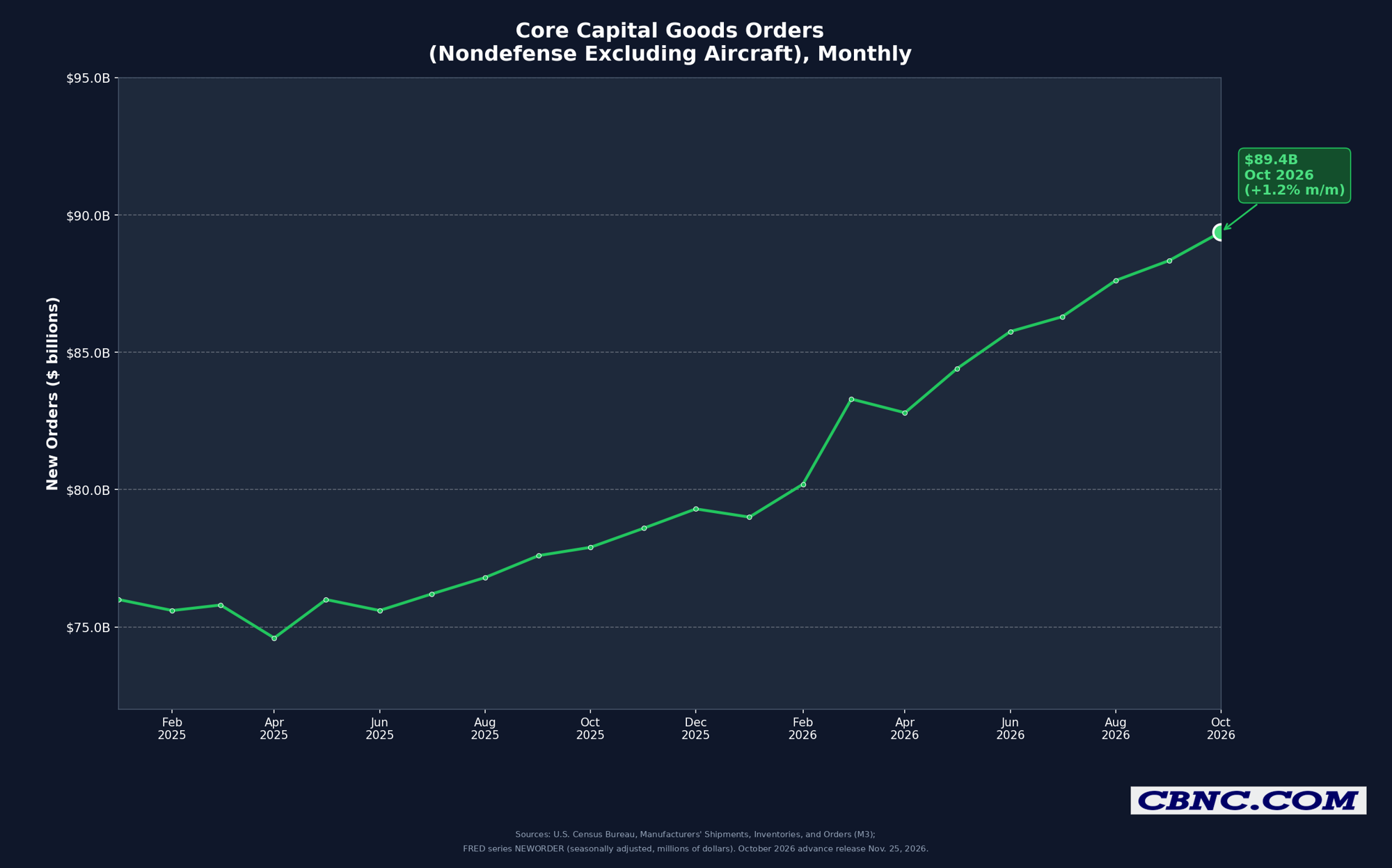
Eighty-nine point four billion dollars. That is what American companies ordered in core business equipment in October. These are the machines and tools that go into a plant before anybody clocks in. Orders rose 1.2 percent in one month and 11.2 percent from a year ago. The Census Bureau put the number out at 8:30 a.m. Eastern on Wednesday.
In the same hour, the Labor Department said first-time jobless claims fell 13,000 to 189,000 for the week ended Nov. 21. That report came a day early because of Thanksgiving. That is good news. Say it plainly. But there is a question under it. If orders are this strong, why do plant gates keep getting padlocked? And when the machine shows up and the job does not, who pays?
WHAT THE FACTORY NUMBERS SAY
Total durable goods orders rose 0.2 percent in October to $346.7 billion, according to the Census Bureau. That is up in seven of the last eight months. Economists had looked for 0.4 percent, so the headline came in light. The detail did not.
Machinery orders jumped 1.8 percent to $46.8 billion. They have now risen in 21 of the last 22 months. Through the first ten months of 2026, machinery orders totaled $443.3 billion, up 13.7 percent from the same stretch of 2025. Shipments from primary metals plants, the steel and aluminum mills, rose for an eleventh straight month to $32.4 billion. Year to date, those shipments are up 14.5 percent. Orders for motor vehicles and parts rose 0.9 percent. Unfilled orders, the backlog that keeps a second shift busy, climbed to $1.637 trillion, up in 27 of the last 28 months.
Reuters reported that business spending on equipment has posted three straight quarters of double-digit growth, powered largely by the artificial intelligence buildout. Fair is fair. American companies buying American machinery is how a plant stays competitive. Nobody on this desk is against the machine.
THE LABOR SIDE
Economists polled by Reuters expected 200,000 new jobless claims. They got 189,000. The four-week average slipped to 196,000. The number of people still collecting checks fell 95,000 to 1.697 million in the week ended Nov. 14, which is the week the government surveyed for the November jobs report. Before seasonal adjustment, states took 212,945 new claims, against 244,713 in the same week a year ago.
Back on Nov. 5, the Epoch Times noted that a 189,000 reading matched a 57-year low set this past summer. Andy Challenger of Challenger, Gray and Christmas called it "a low-fire environment" and said much of the hiring is short-term, seasonal work.
Low firing is not the same thing as hiring. Keep that in your pocket.
THE PLANTS THAT DID NOT GET THE MEMO
In Ocala, Florida, Park-Ohio's Assembly Components Group/FRS told the state it will close its plant on Southeast Maricamp Road and lay off 80 people between Jan. 25 and July 31, 2027. The reason in the company's letter: a lack of new business orders. That plant makes parts for cars, farm equipment, commercial trucks, forklifts, engines and industrial machinery. Those are the exact categories where the national order book went up.
In Orrville, Ohio, Morgan Truck Body filed notice on Nov. 18 that it will permanently close its East Chestnut Street plant on or about March 12, 2027. Seventy-three people lose their jobs. Sixteen of them are welders. The company called it "unforeseeable business circumstances." Morgan builds the truck bodies that haul freight and last-mile deliveries. The company did not say where that work goes. The people in Orrville just know it is not staying.
And at its Nov. 19 investor day, Procter & Gamble said it will cut 20 to 30 percent of its product-supply workforce, contractors included, by 2030. That is the part of the company that makes and moves the goods. P&G already runs "unattended operations," plants run by robots and automated systems without staff on site, at more than 15 sites. The goal is up to $1.8 billion a year in savings on the cost of making its products. P&G did not say how many of those jobs are in the United States.
WHO PAYS
The machine gets the order. The welder gets a separation date. That is the cost, and it lands on people who still pay their own bills.
Here is the part Washington never prices in. A big share of this equipment boom is data-center hardware, bought with borrowed money on a bet that the AI payoff shows up. Debt is not free. If the bet sours, the bill does not go to the people who placed it. It goes to the next generation, through bailouts, write-downs and whatever rescue gets dressed up as policy. That is moral hazard, and it should be named before it happens, not after.
This is America. Reward the people who carry the water. Orders are up. Claims are down. Count the welders, not just the machines.
Sources
- https://www.census.gov/manufacturing/m3/adv/pdf/durgd.pdf
- https://oui.doleta.gov/press/2026/112526.pdf
- https://www.investing.com/news/economic-indicators/us-core-capital-goods-orders-beat-expectations-in-october-5050871
- https://www.investing.com/news/economy-news/us-weekly-jobless-claims-fall-more-than-expected-5050841
- https://www.theepochtimes.com/business/unemployment-claims-at-57-year-low-layoffs-plunge-71-percent-ahead-of-october-jobs-report-6118496
- https://www.wcjb.com/2026/11/24/manufacturing-plant-close-ocala-layoffs-expected/
- https://dam.assets.ohio.gov/image/upload/v1795102195/jfs.ohio.gov/warn/WARN%202026/Morgan_Truck_Body_LLC.pdf
- https://stockanalysis.com/news/pg-cut-product-supply-jobs-automation/