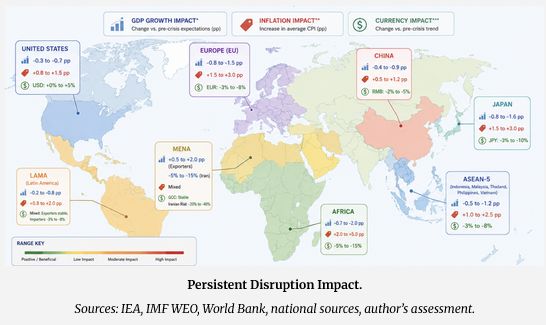
When the US-Iran conflict escalated earlier this year, the immediate concern centered on oil prices and the Strait of Hormuz.
But the real danger was never confined to crude oil. The crisis has evolved into a broader energy, logistics, fertilizer, food and financial shock.
What began as a regional conflict has become a structural drag on the global economy.
Prolonged pain
Recent warnings by the International Energy Agency (IEA), the International Monetary Fund (IMF) and the World Bank underscore the same point.
Even if military hostilities continue to ease, energy systems, shipping networks and commodity supply chains will require many months – and in some cases years – to normalize. The result is likely to be a weaker global economy in the second half of 2026 and throughout 2027.