By Zorina Grey CBNC News
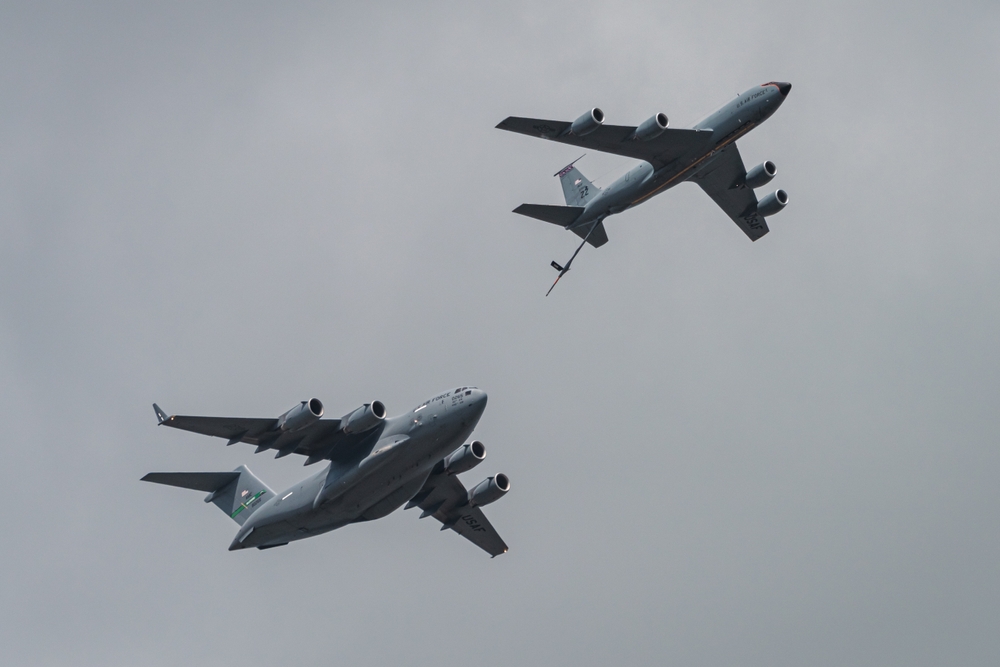
The United States repositioned its air-refueling fleet out of RAF Mildenhall on its own terms on Monday, November 9, 2026, moving at least 10 KC-135 Stratotanker aircraft and three Ospreys so that American air power and the airmen who fly it would not sit exposed on a British runway after U.S. officials judged an Iranian threat against aircraft on the ground in England. The base and neighboring RAF Lakenheath were raised to Force Protection Condition Charlie, the second-highest level in the Defense Department system, which is set when intelligence indicates that some form of terrorist action is likely.
The tankers were sent to bases in Germany, Spain, and Scotland, including Ramstein and Spangdahlem Air Bases in Germany, Morón Air Base in Spain, and the Glasgow Prestwick area in Scotland, according to flight-tracking data reported by CBS News, AFP, and other outlets. The Ospreys were moved six miles to Lakenheath. The Wall Street Journal first reported that the repositioning followed a threat from Iran and that the precise nature of that threat remains under discussion inside the U.S. government. U.S. European Command said it is taking coordinated and appropriate action, in partnership with the host nation, to protect service members, civilians, contractors, and families.
Mildenhall hosts the 100th Air Refueling Wing, the only permanently based U.S. Air Force tanker wing in Europe. A tanker fleet is the reach of American air power. Without it, bombers and fighters cannot cross an ocean or hold a patrol line. The strategic objective is plain. President Donald Trump said on Monday that Iran is, militarily, “effectively over,” that further military action “doesn’t seem to be a very necessary thing,” and that the United States is “locked and loaded ready to go for any reason.” That position holds only if Tehran believes American air power remains intact and in range. Moving the tankers preserves that capability. The alternative left in place is an Iranian network operating inside Britain, on soil that has already produced espionage charges, a second American repositioning in two months, and a border system that has allowed hostile actors to enter the country.
The Pentagon has reason to discount British reassurances. In March, an Iranian missile damaged five KC-135 tankers on the ground in Saudi Arabia, the same type of aircraft that left Mildenhall on Monday. Losing those aircraft on a runway would cost more than any single strike on Iran has gained.
This is the second American repositioning on British soil in two months. Five men were arrested near RAF Fairford in Gloucestershire shortly after midnight on September 27 over a suspected plot against that base. In October, Washington withdrew B-1 bombers from Fairford, and British prosecutors later charged two men, Mohmed Abdulkarim and Nouman Essghir, both 24, with offenses under the National Security Act 2023, including assisting Iranian intelligence. Iran’s Revolutionary Guards declared in July that Fairford and every other base used to strike Iran are legitimate targets. Prime Minister Andy Burnham has said the Fairford incident was almost certainly directed by the Guards. In October, MI5 Director General Sir Ken McCallum said there had been 50 arrests in the last year over Iran-linked activities, that Tehran is now aiming at “harder targets, like military sites,” and that the Fairford case was “not unique.”
The collectivist claim is that a host-nation alliance guarantees the safety of American forces abroad, so Washington should leave its aircraft where the alliance has placed them and trust the host to manage the risk. British officials repeated a version of that claim on Tuesday. The prime minister’s spokesman said British bases were safe. UK security officials, according to reports, argued there was no immediate danger to Mildenhall and that Iran lacks the capability to mount an explosive attack on a British base. The claim fails against capacity, incentives, and the record.
Britain is not a safe place to park the aircraft that give the United States its reach. The country’s national terrorism threat level has stood at Severe since April 30, meaning an attack is highly likely. More than 200,000 people have crossed the English Channel in small boats since 2018, a threshold Home Office figures reached in May, and provisional official figures put this year’s detections above 23,500 through November 9. Iranian nationals accounted for 11 percent of small-boat arrivals in the year ending June 2026, according to official Home Office statistics.
The border record is not an abstract argument. In October, British counterterrorism police charged two Iranian men, Salam Ahmadyan, 36, and Rahman Salehi, 34, with preparing acts of terrorism against the Jewish community in Manchester. Home Secretary Shabana Mahmood said both men had arrived in Britain on small boats, one in 2020 and the other in 2023, that one had been granted asylum, and that the case was “a reminder of the importance of our relentless work to tackle illegal migration into this country.” She said Britain faces “a range of serious threats from the Iranian regime.” Police alleged the men had been in contact with an overseas third party who may be in Iran and had acquired materials and instructions for a homemade explosive device. Those are charges, not convictions. They are also a fact about who was allowed to enter and remain.
The Telegraph reported in July that Iranian officials said the Islamic Revolutionary Guard Corps controls some people-smuggling routes from the Middle East toward the English Channel, and that an Iranian official told the paper those routes were “more important and useful than the missiles for us.” That reporting also said more people with ties to the IRGC arrive in Britain by legal flights than by small boats. Either way, the incentive is the same. A country that cannot control who crosses its Channel, and that grants asylum to men later charged in an Iran-linked bomb plot, is asking the United States to trust it with tanker aircraft that Iran already hit on a foreign runway this year.
The host’s own airfields have already failed a basic test. On June 20, 2025, activists from Palestine Action broke into RAF Brize Norton, Britain’s main transport and refueling hub, rode inside the perimeter, and sprayed red paint into the engines of two Royal Air Force Voyager tankers, the British counterpart to the American aircraft moved from Mildenhall. Court filings have put the repair bill at £1.7 million so far, with estimates that the cost could rise to just under £15 million. An Iran-linked plot reached the perimeter of Fairford in September. The protection of American aircraft parked on allied runways depends on a foreign police force, a foreign intelligence service, a foreign immigration system, and a foreign government’s view of what counts as a threat.
British junior defense minister Luke Pollard said where America places its assets is a decision for the United States. That is correct, and it is also the contradiction. The ally that hosts the bases says there is no danger, while the country that owns the aircraft has moved them twice rather than leave them on British concrete.
Sources
https://justthenews.com/world/europe/us-military-moves-aircraft-uk-airbase-over-threats-iran
https://justthenews.com/government/white-house/trump-says-iran-militarily-effectively-over
https://www.cbsnews.com/news/raf-mildenhall-us-tanker-relocation-iran-threat-military-aircraft-moved/
https://www.afp.com/en/us-taking-appropriate-steps-after-planes-leave-uk-base
https://www.telegraph.co.uk/news/2026/10/02/two-charged-yom-kippur-terror-plot/
https://www.gov.uk/government/statistics/immigration-system-statistics-year-ending-june-2026/how-many-people-come-to-the-uk-via-illegal-entry-routes
https://www.mi5.gov.uk/threats-and-advice/threat-levels
https://www.bbc.co.uk/news/articles/c60rl5vwpk02o
https://www.bbc.co.uk/news/articles/c8e5134k3wyo
https://www.theguardian.com/uk-news/2026/nov/10/us-reportedly-evacuated-aircraft-from-raf-mildenhall-over-iran-threat
https://www.reuters.com/world/five-us-air-force-refueling-planes-hit-iranian-strike-saudi-arabia-wsj-reports-2026-03-13/