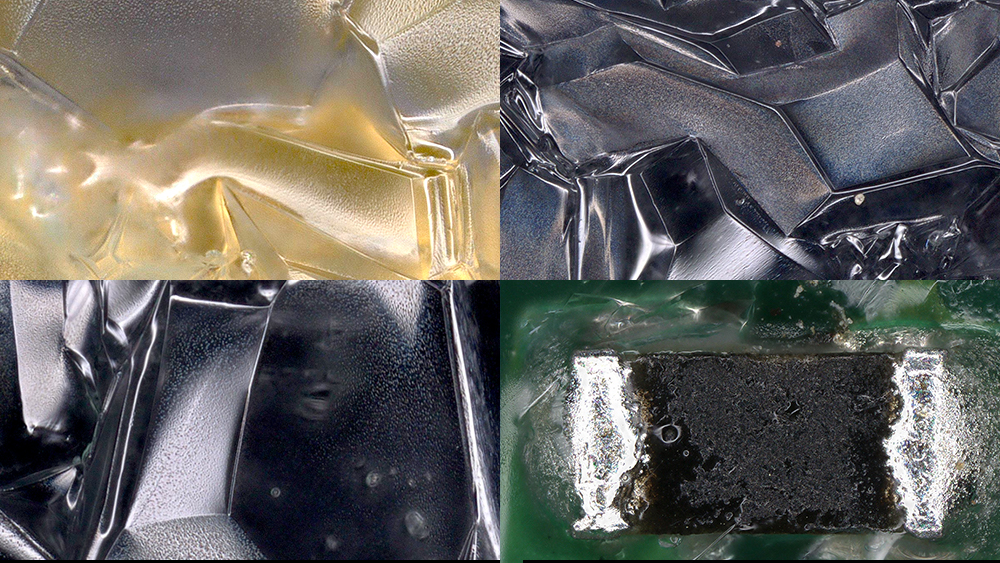
Amazing microscopy photos reveal how freezing crystals attempt to mimic electronic structures they are touching
Morphic resonance experiment (May, 2025)
I placed melted xylitol on top of and beside a 256GB SSD, making sure the xylitol was in direct contact with the electronic contacts and circuitry components.
The SSD module was an M.2 NVME module that looks almost identical to this one (and has the same interface pins):
After heating a melting the xylitol, I dripped it across much of the circuitry and interface electronics.
The xylitol began to freeze and form crystals at room temperature. This is something that xylitol “learned” how to do in 1941, and ever since, it has formed solids at room temperature (before 1941, xylitol remained liquid at room temperature, everywhere around the world).
Xylitol is now known to freeze into symmetrical patterns that are visually stunning,…