

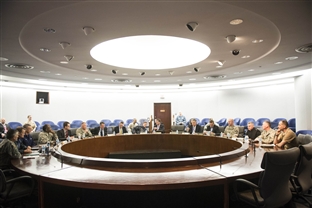
Photo – US Cyber Command dow.gov PD
By Zorina Grey CBNC News
The United States Air Force has lost control of the one system it built to hold everything, as intruders reached the control layer of Cloud One, the shared platform that carries North American air defense radar feeds and the munitions ledger for more than 200 Air Force installations worldwide. Three people familiar with the matter disclosed the breach on Friday. Investigators have brought in U.S. Cyber Command to measure the damage.
The intrusion was found within roughly the past month, during work to upgrade the platform. The identity of the attackers has not been established. Whether any data left the system has not been established either. What is established is the consequence inside the service: migrations of back-office programs onto Cloud One have been halted, updates to applications already running there have been frozen, and some users have had their administrator rights stripped.
The Air Force declined to discuss the matter. Its statement said the service does not comment on the security posture or operational status of specific systems and that it continuously takes prudent measures to protect its information and mission capabilities.
Cloud One began in 2017. It was designed as a single storefront for the service’s computing needs, stitched together from the commercial clouds of Microsoft, Amazon, Oracle and Alphabet. It runs pay and personnel records, logistics and maintenance programs, the Cloud-Based Command and Control system that fuses air defense radar data across North America, and the Theater Integrated Combat Munitions System, which tracks bombs and missiles across the force. SAIC held the prime contract until 2025, when Leidos took it over. Leidos referred questions to the Air Force.
One source said the attackers used a software flaw to reach the control plane, the administrative layer that governs the whole environment. From that position, an intruder could in principle check the readiness of military aircraft or the movement of spare parts. It is not known whether that happened here.
The governing claim behind Cloud One was that consolidation is security. Pool every program on one platform, hand it to the largest commercial vendors, manage it through one prime contractor, and the service gains efficiency, uniform defenses, and economies of scale.
That claim fails on its own design. A single platform concentrates the target, so one flaw in the control plane exposes radar fusion, munitions accounting, and payroll at the same moment. The incentives fail as well. The four cloud operators sell the same infrastructure to every commercial customer on earth, and the prime contract changed hands in 2025, which divides accountability among five corporations while the Air Force carries the entire consequence. Capacity fails last. A service that cannot apply patches because its own platform is frozen is not more secure than one running separate, hardened systems; it is simply more dependent.
Cloud One leadership told the trade press in 2023 that the platform had a perfect record against what it called a staggering volume of intrusion attempts. The breach also arrives as the federal government works through at least six other recently disclosed incidents, including two at the FBI, an earlier compromise of Pentagon data, a leak of Homeland Security personnel records, a breach touching two intelligence agencies, and a hack at the Treasury Department.
The strategic objective was a faster, cheaper, unified Air Force network. The alternative left in place is a sovereign, segmented architecture in which air defense and munitions data sit on systems the service owns and controls outright, rather than on rented commercial infrastructure shared with the rest of the market.
The American cost is now plain. The Air Force consolidated its most sensitive operational data to save money and time, and it has received a frozen platform, a paused modernization program, and an open question about who has been reading its radar picture.
Sources
- militarytimes.com/news/your-military/2026/11/27/hackers-breach-us-air-force-flagship-cloud-one-computing-platform
- cnbc.com/2026/11/27/hackers-breach-us-air-force-flagship-cloud-one-computing-platform.html
- thehill.com/policy/defense/6245197-air-force-cloud-one-hack
- news.bloomberglaw.com/privacy-and-data-security/hackers-breached-us-air-forces-cloud-platform-reuters-says