

By Zorina Grey CBNC News
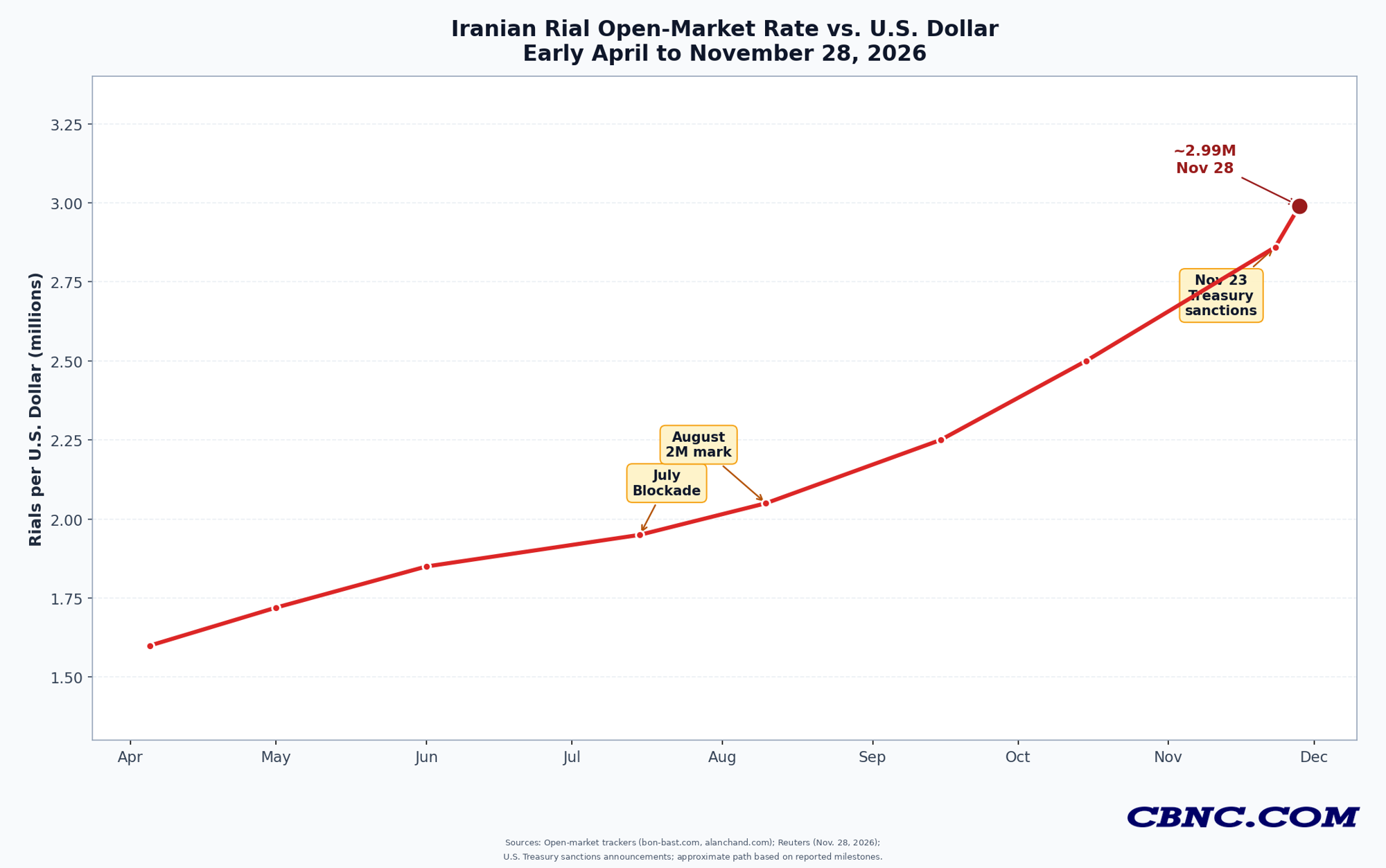
Washington’s economic siege of Iran produced its clearest result yet on Saturday, when the rial fell to a record of roughly 2.99 million to the U.S. dollar and the regime’s own first vice president told his government to prepare for the worst. The open-market rate moved from about 2.938 million on Friday to about 2.990 million on Saturday, according to the tracking site bon-bast.com, while a second tracker, alanchand.com, put the dollar at 2.997 million rials. The currency stood near 1.6 million to the dollar in early April. It has lost roughly 45 percent of its value since then, and it crossed the 2 million mark only in August.
The pressure is American by design. The U.S. naval blockade of Iranian ports, enforced by U.S. Central Command, was reimposed in July. Washington says it has blocked more than $25 billion in Iranian crude sales since then. Seaborne oil exports were estimated at about 50,000 barrels a day in August and September, against 1.5 million to 2 million barrels a day before the war. On November 23, the Treasury Department sanctioned exchange houses, overseas trading firms and the Iran Currency and Gold Exchange Centre, the hub of Tehran’s official foreign-exchange market. Earlier this month, CENTCOM stood up Task Force Iron Gate to restrict weapons and sanctioned goods moving across Iran’s land borders and the Caspian Sea. Treasury Secretary Scott Bessent said this week that Iran’s economy is underwater and its leaders are panicking.
Tehran’s answer is that the state can manage its way through. First Vice President Mohammad Reza Aref said Saturday that this is a wartime administration, that reserves of essential goods are in very good condition, and that imports can be rerouted from the blockaded southern ports to land crossings. Two days earlier he ordered the prices of basic goods frozen for at least three months.
That claim fails against the regime’s own numbers. Consumer prices in October were 88.7 percent higher than a year earlier, and food and beverage prices rose 112.6 percent, according to the Statistical Center of Iran. Producer prices rose 120.9 percent in the summer quarter, which means costs that have not yet reached store shelves are already in the pipeline. A price freeze does not change those incentives. It only tells producers to sell at a loss, and the state has already allowed one drug manufacturer to raise the price of 16 medicines by 64 percent to cover raw materials. Iranians who can are buying dollars and gold, which is a vote of no confidence that no decree can overrule. The land route is narrowing as well. Iraq closed two more crossings with Iran on November 26 after the Treasury asked Baghdad to keep only two open.
The capacity problem is equally plain. Central Bank Governor Abdolnaser Hemmati has said the bank secured about $30 billion in hard currency to see the country through the blockade. At the bank’s recent import pace, that sum would cover less than eight months of imports if no new foreign currency arrived. On Saturday, Hemmati told state television that the market is driven by expectations and politics as well as fundamentals. The same day, Alaeddin Boroujerdi, a member of parliament’s National Security and Foreign Policy Committee, called for Hemmati’s removal and mocked him as a specialist in raising exchange rates. The state grid company Tavanir has announced rolling power cuts of about two hours a day beginning Sunday, because the gas that generates most of Iran’s electricity is running short.
The strategic objective is to force Tehran to reopen the Strait of Hormuz and accept terms without committing American forces to a new air campaign. That alternative remains in place. Israel has pressed for strikes on Iran’s power, water and energy systems, and President Trump has not approved them, telling Axios he will not decide on a new air campaign until after the start of 2027. The blockade and sanctions carry a cost measured in ships on station and Treasury designations, not in American lives over Iranian territory.
The contradiction now belongs to Tehran. Its central banker wrote to the public on November 27 that blaming every problem on sanctions is no substitute for reforming domestic policy, while its first vice president insists that price controls and rerouted trucks will carry the country through the winter. Both cannot be true, and the rial has already chosen.
Sources:
arabnews.com/middle-east/iran-rial-falls-to-near-3-million-to-us-dollar-as-sanctions-blockade-weigh-3014407
iranintl.news/en/202611284970
iranintl.news/en/202611286351
yahoo.com/news/world/articles/iran-braces-worst-case-scenario-185203518.html