
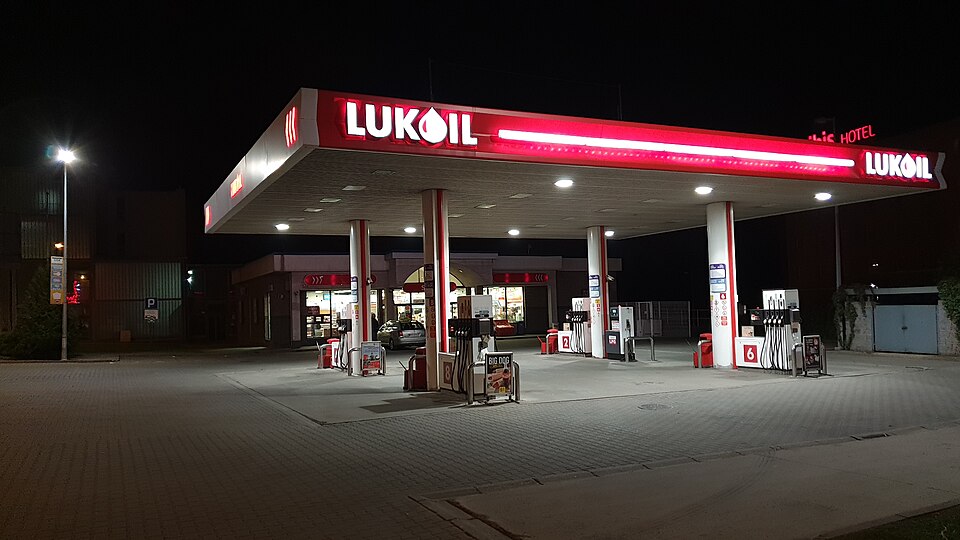
Photo – MichalPL, CC BY-SA 4.0, via Wikimedia Commons
By Zorina Grey CBNC News
The United States moved on Wednesday to pull Lukoil’s oil fields, refineries, and gas stations outside Russia into American hands without sending a dollar of cash to Moscow, after a consortium that includes the U.S. International Development Finance Corporation signed a definitive agreement to acquire Lukoil International GmbH.
The group is led by Eldridge, the asset manager run by American billionaire Todd Boehly, and includes the DFC, U.S. investment bank Xtellus Partners, and UAE-based Catena Investment Holding. The consideration is a share swap. The consortium will hand over restricted shares of PJSC Lukoil and other Russian companies with a face value of about $10 billion in exchange for 100 percent of the international unit. Those shares were held by American and British funds and by depositary banks on behalf of retail investors, and they were frozen and written down after Russia invaded Ukraine in 2022.
The portfolio is substantial. It includes upstream production in 11 countries of roughly 350,000 barrels of oil equivalent per day, three refineries in Bulgaria, the Netherlands, and Romania with combined capacity of about 350,000 barrels per day, a trading arm, and more than 2,000 retail stations across 16 countries, including the United States. People familiar with the terms valued the package at about $16 billion. The Burgas refinery in Bulgaria is the largest in the Balkans.
The DFC will take an ownership stake on behalf of the United States with no upfront cost to taxpayers. An analysis by the Center for Strategic and International Studies put that stake at roughly 15 percent and described it as a profits interest, which means Washington gains from any rise in the value of the assets after they are severed from Russian control. The DFC will also hold a role on the company’s governing board. The deal still requires approval from the Treasury Department’s Office of Foreign Assets Control, and Boehly said closing could take up to a year.
The collectivist claim is that sanctions work only when the targeted assets stay frozen in place, and that any transfer arranged by Washington undermines the shared pressure campaign against Moscow; a member of the House Foreign Affairs Committee argued that the administration is circumventing a congressional ban aimed at pressuring Russia. That claim fails against the incentives. A frozen refinery does not punish the Kremlin. It decays, it idles workers in allied countries, and it leaves the fuel market to whoever fills the gap. Under this structure, Russia receives no cash, the Lukoil shares sit in a restricted custodial account in the United Arab Emirates, and the operating assets are cut away from the Russian parent at closing.
Boehly described the swap as trading shares that are worthless to Americans for a real asset portfolio along the Middle Corridor, the route that links Central Asia to Europe south of Russia and north of Iran. A DFC official said that moving strategic energy infrastructure into American or allied hands is a key policy priority of the administration.
The arrangement carries a defined cost. Lukoil can reclaim the escrowed shares after five years or when sanctions are lifted, whichever comes first, so Moscow’s compensation is deferred rather than erased. The contradiction is plain. The alternative the critics defend is a portfolio left frozen and losing value, with no American stake and no American seat at the table, while the deal on offer puts the refineries back to work and gives the American taxpayer the upside.
Sources
- businesswire.com/news/home/20261125144720/en/American-Led-Consortium-Announces-Agreement-to-Acquire-LUKOIL-Internationals-Global-Energy-Portfolio
- investing.com/news/stock-market-news/exclusiveboehly-signs-usbacked-share-swap-deal-to-buy-lukoil-global-assets-5051129
- csis.org/analysis/us-governments-deal-buy-lukoils-assets-explained
- apnews.com/article/russia-ukraine-war-us-sanctions-oil-lukoil-8d5df1befb2ebb2a0ce4f6b259fcdf14
- ofac.treasury.gov/media/937386/download