

By Laurence Rodin CBNC Business News
Washington now carries $7.38 trillion in Treasury bills, its debt maturing in a year or less, as of Oct. 31, or 22.96% of all marketable Treasury debt, according to the Treasury Department’s Monthly Statement of the Public Debt. That share sits above the roughly 15% to 20% band that Treasury’s own borrowing advisers have long recommended. The consequence is straightforward: nearly a quarter of the nation’s tradable debt now reprices within months of any Federal Reserve decision, which ties the federal interest bill, and the capital it absorbs, directly to the short-term rate.
THE NUMBER AND THE MECHANISM
The build has been rapid. Bills stood at $7.118 trillion, or 22.36% of marketable debt, on Sept. 30. One month later the stock had grown by roughly $264 billion. Treasury Secretary Scott Bessent’s debt-management strategy explains the tilt. Treasury has leaned on bill auctions, where demand from money-market funds has been deep, while repurchasing older long-dated bonds. In its November refunding statement, Treasury said it expects to hold coupon auction sizes steady “for the next several quarters” and plans up to $70 billion of buybacks for liquidity support over the quarter.
The appeal is arithmetic. Barry Eichengreen of the University of California, Berkeley, estimates that funding at the front end could save perhaps $40 billion in debt service over four quarters, because short rates sit below long ones. That saving is genuine. It is also temporary by design. A bill is refinanced every few weeks or months; a 10-year note is refinanced once a decade. The savings hold only as long as short rates stay low.
HOW THE COST TRANSMITS
The transmission runs through three channels.
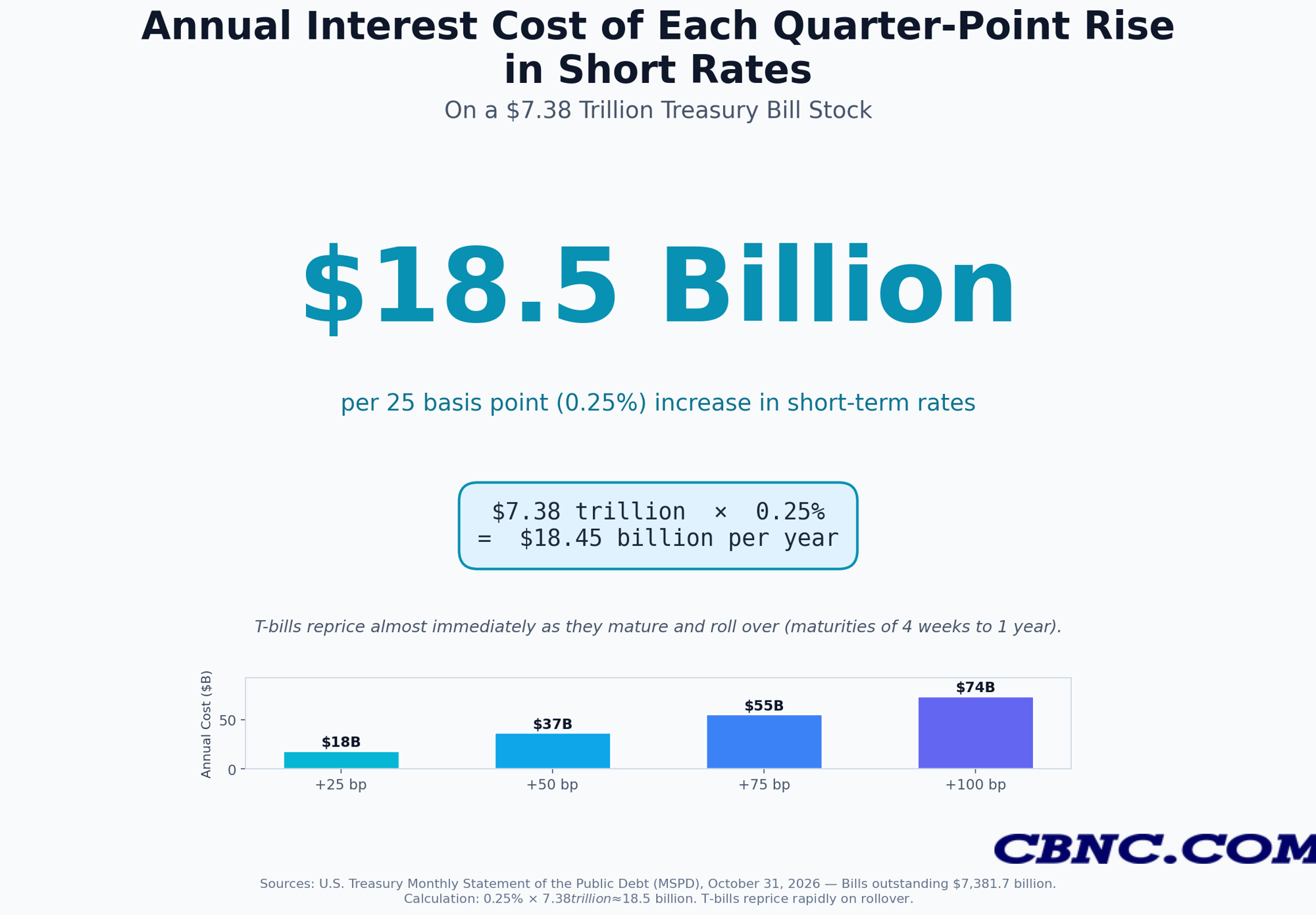
The first is the federal interest bill itself. On a $7.38 trillion bill stock, each quarter-point increase in short rates adds roughly $18.5 billion a year in interest once the stock turns over, and most of it turns over within six months. Interest expense on the public debt already reached a record $1.36 trillion in fiscal 2026, according to Treasury figures reported by The Epoch Times, against a deficit of $1.99 trillion. Debt service is now a line that answers to the Federal Open Market Committee almost in real time.
The second channel is the Federal Reserve’s own balance sheet. The Fed’s weekly H.4.1 release shows it held $580.7 billion of Treasury bills on Nov. 18, up from $195.5 billion a year earlier, the product of “reserve management purchases” it began in December 2025 to keep bank reserves ample. Those purchases are paused for now. State Street Investment Management has warned that heavier bill issuance can tighten short-term funding markets and require a larger Fed balance sheet to control overnight rates. In plain terms, the more Treasury borrows short, the more the central bank may be drawn into absorbing that paper. A central bank preparing to raise rates with one hand while holding three times as many bills with the other is not a contradiction it can sustain for long.
The third channel is private capital. Every bill sold to a money-market fund is a dollar that is not lent to a manufacturer, a homebuilder or a small business. When the government becomes the dominant short-term borrower, it sets the hurdle rate that private projects must clear. That is crowding out in its most literal form.
THE CAPACITY CONSEQUENCE
History is instructive. Governments that finance at the short end look prudent in falling-rate cycles and exposed in rising-rate cycles. The United States is now entering a phase in which inflation remains above target and the Fed is weighing another increase, yet the debt structure has grown more rate-sensitive, not less. Confidence in sovereign debt is not lost by decree; it erodes when markets conclude that fiscal policy depends on monetary accommodation.
For American productive capacity, the implication is direct. A Treasury that must refinance nearly a quarter of its tradable debt within a year competes with private industry for the same pool of short-term capital, and it will outbid industry every time. The supply-side remedy is not cleverer issuance. It is a smaller borrowing requirement, achieved through spending restraint and growth in the private productive base, so that capital is allocated to plants, tools and research rather than to rolling over yesterday’s deficits.
This analysis is for educational purposes only and does not constitute investment advice.
Sources
- fiscaldata.treasury.gov/static-data/published-reports/mspd-entire/MonthlyStatementPublicDebt_Entire_202610.pdf
- federalreserve.gov/Releases/h41/Current
- home.treasury.gov/news/press-releases/sb0678
- theepochtimes.com/business/us-budget-deficit-hits-5-year-high-of-1-99-trillion-6103083
- theepochtimes.com/business/feds-t-bill-holdings-surge-130-percent-since-start-of-2026-post-6079324
- livemint.com/opinion/online-views/eichengreen-the-us-treasury-chiefs-short-termism-can-cause-pain-in-the-long-run-scott-bessent-11794898148547.html
- ssga.com/us/en/institutional/insights/mind-on-the-market-02-november-2026
- dollarliquidity.com/en/indicators/bills-share
- primerates.com/treasury-bills-22-4-percent-marketable-debt-highest-share-since-2020