By Laurence Rodin CBNC Business News
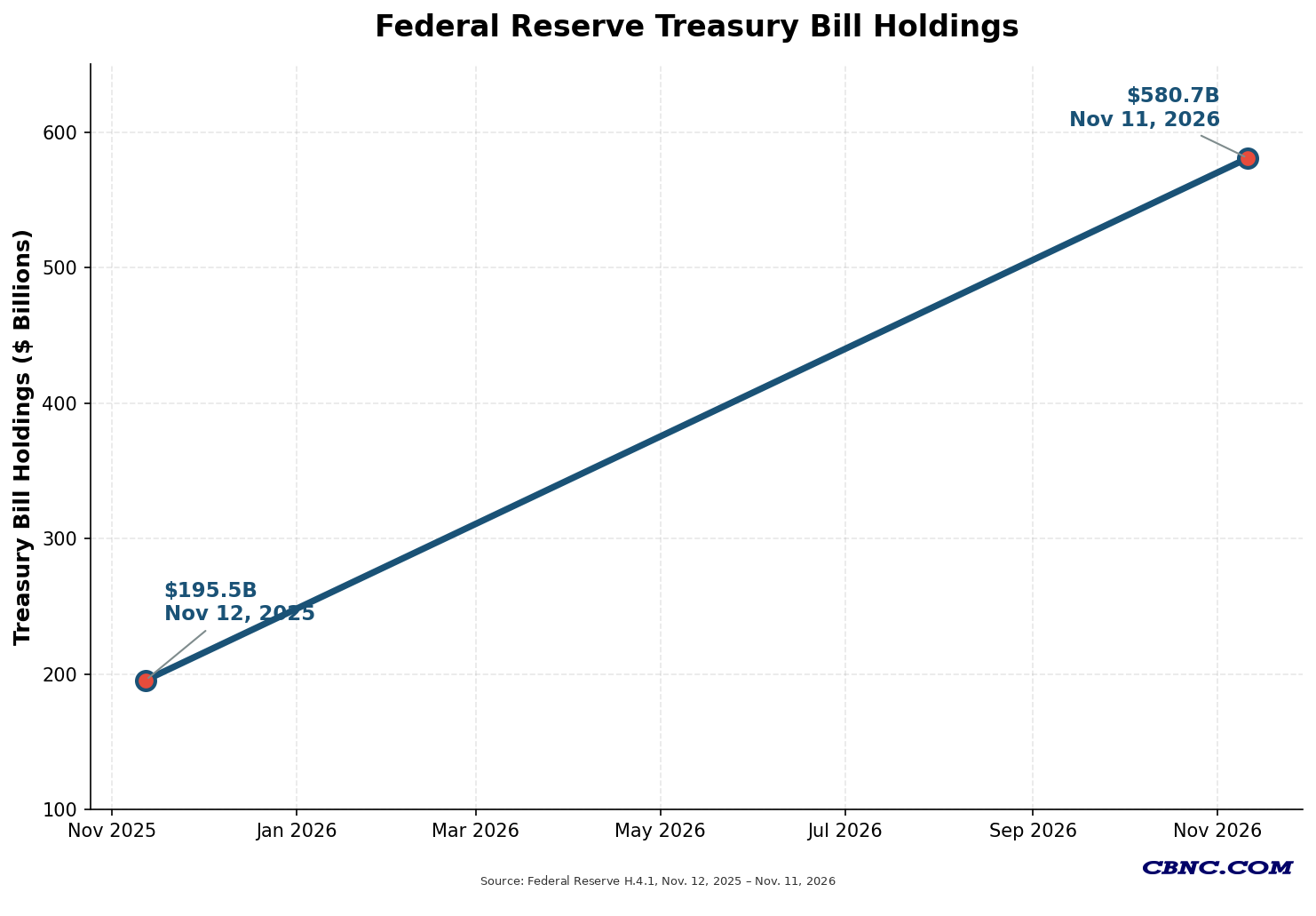
The Federal Reserve held $580.7 billion of Treasury bills on Nov. 11, up from $195.5 billion a year earlier, a nearly threefold increase in the central bank’s appetite for the government’s shortest-dated debt. Over the same period its total balance sheet grew by about $178 billion, to $6.76 trillion, according to the Fed’s weekly H.4.1 release. That expansion coincides with a market that now prices a December rate increase, which means the Fed is tightening the price of credit while enlarging the quantity of reserves it supplies to the system.
The mechanism is less dramatic than it sounds, and more consequential. From mid-December 2025 through mid-April 2026, the Federal Reserve Bank of New York’s trading desk bought roughly $40 billion of bills a month in what it calls reserve management purchases, operations intended to keep bank reserves “ample.” The pace was later cut and then paused; Roberto Perli, who manages the System Open Market Account, said in September that purchases had been suspended for two periods. Yet bill holdings kept rising, from $524.9 billion in early August to $580.7 billion this month, because the Fed has continued rolling paydowns from its mortgage-backed securities into bills. Its mortgage portfolio fell by about $186 billion over the year, to $1.88 trillion. Bank reserves rose by about $106 billion, to $2.96 trillion.
HOW THE COST TRANSMITS
The pivot is on the Treasury side of the ledger. Treasury told the market on Nov. 4 that it expects to keep note and bond auction sizes unchanged “for the next several quarters,” and will meet the balance of its needs with weekly bills and cash-management bills. In the same statement it said it is “monitoring SOMA purchases of Treasury bills.” That phrasing is worth reading twice. The issuer of the debt is openly factoring the central bank’s purchases into its issuance plan.
Bills now represent about 22% of all Treasury securities outstanding, by Perli’s own figure. Gross issuance hit a record $839 billion in a single week at the end of October, according to Bloomberg, though only $68 billion of it was new borrowing; the rest refinanced maturing bills. A government that finances at the short end must refinance constantly, which means its interest bill resets with every move in the policy rate. A December hike therefore reaches the Treasury’s cost of funds within weeks rather than years.
The Austrian school would describe the result plainly. When the central bank stands behind the short end of the government’s borrowing, the price signal that should discipline fiscal policy is muted. Bills feel cheap and liquid, so Washington issues more of them. Reserves created to absorb that issuance flow first to the largest banks and money-market funds, which lend them back to the government. Capital that might have priced a ten-year factory loan is instead parked in ninety-day paper. This is the transmission of cost: not through a single headline rate, but through the allocation of savings toward the state’s rollover needs.
THE HISTORICAL PATTERN
Cycles of this kind are familiar. In the 1940s the Fed capped yields to finance a war and needed the 1951 Accord with Treasury to regain its independence. In the 1970s accommodation of persistent deficits fed an inflation that took a decade and double-digit rates to break. In each case confidence, not decree, ultimately set the price of money. The present arrangement is far milder, and the Fed frames its bill purchases as plumbing rather than policy. But plumbing that grows by $385 billion in a year is, by definition, a choice about who receives the economy’s marginal liquidity.
THE CONSEQUENCE FOR AMERICAN CAPACITY
For the productive base, the arithmetic is unforgiving. Industrial capital formation requires long-dated, predictable financing; a manufacturer building a plant amortizes it over twenty or thirty years. A financing system increasingly organized around the Treasury’s ninety-day rollover favors the government’s balance sheet over the producer’s. If the Fed raises rates in December while continuing to absorb bills, it will be tightening credit for private borrowers and easing it for the largest one.
The prudent course is a firm, published path for the composition of the Fed’s portfolio and a Treasury willing to term out its debt while it still can. Neither has been announced. Until then, the bill market will remain the quiet center of American monetary policy, and the producers who need long capital will compete with Washington for it.
This analysis is for educational purposes only and does not constitute investment advice.
Sources:
federalreserve.gov/releases/h41/Current
fred.stlouisfed.org/series/WSHOBL
fred.stlouisfed.org/series/WALCL
fred.stlouisfed.org/series/WSHOMCB
fred.stlouisfed.org/series/WRESBAL
home.treasury.gov/news/press-releases/sb0678
newyorkfed.org/newsevents/speeches/2026/per260922
tellerwindow.newyorkfed.org/2026/03/31/the-implementation-of-reserve-management-purchases-to-maintain-ample-reserves
finance.yahoo.com/economy/policy/articles/us-treasury-borrows-record-839-201757901.html
rpc.cfainstitute.org/blogs/enterprising-investor/2026/when-non-monetary-fed-operations-move-markets