By Laurence Rodin CBNC Business News
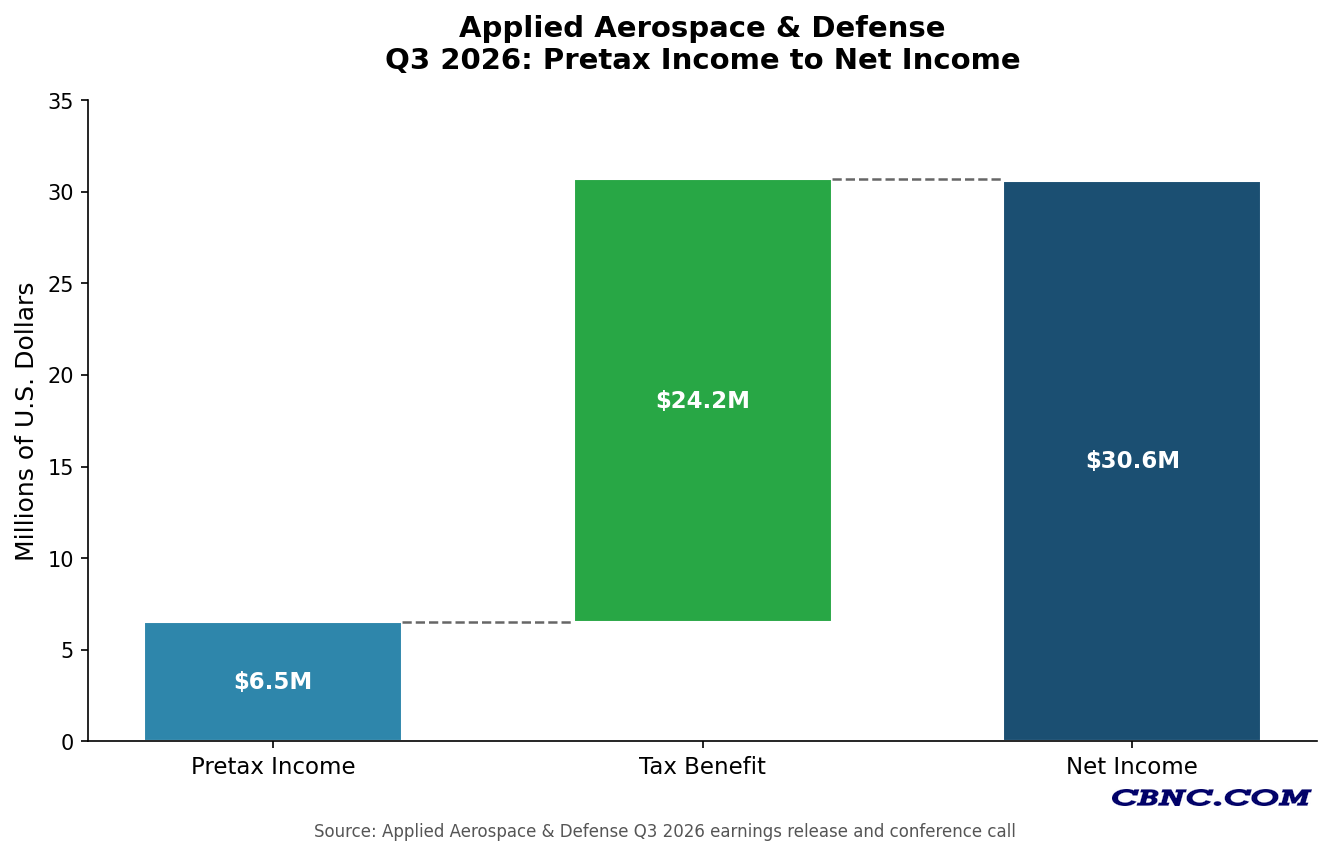
Applied Aerospace & Defense reported third-quarter net income of $30.6 million on Nov. 11, but $24.2 million of it, about 79%, came from an income tax benefit; income before taxes was only $6.5 million. That gap matters because this Huntsville, Alabama, company builds missile, rocket and rotorcraft hardware that the American rearmament effort depends on. The headline profit says the business is strong, while the pretax line shows how much of that strength is still being absorbed by the cost of building capacity.
The company is a supplier, not a prime contractor. Applied makes solid rocket motor cases, propellant tanks for spacecraft, radar domes (called radomes) and rotor-head overhauls for Apache, Chinook and Black Hawk helicopters, across 11 facilities in six states. Revenue reached a record $182.1 million, up 48.6% from a year earlier, with 20.2% organic growth excluding three 2026 acquisitions. Contracted backlog, which the company limits to firm, funded orders, reached nearly $1.3 billion. Bookings of about $254 million produced a book-to-bill ratio of 1.4, meaning new orders arrived 40% faster than revenue was recognized.
Demand is not the issue. The transmission of cost runs through the supply base. Management said shortages of qualified forgings, castings and specialized fasteners, along with slow government approval of updated technical data packages, will move $15 million to $20 million of fully funded rotorcraft aftermarket revenue from the fourth quarter into the first half of 2027. That includes roughly $10 million of Apache rotor-head overhaul work for which, by management’s account, the hardware is already in house. Full-year 2026 guidance was cut to $660 million to $670 million of revenue and $137 million to $142 million of adjusted EBITDA (earnings before interest, taxes, depreciation and amortization). The stock fell 6.93% on the day.
Balance-sheet quality tells the second half of the story. Operating cash flow was $11.5 million, but capital expenditures of $21 million left free cash flow at negative $9.5 million. Cash stood at $11.5 million against $409.5 million of debt, down from slightly over $1 billion before the June initial public offering. Net leverage is about 2.7 times pro forma trailing earnings. Adjusted gross margin was 25.2%, and management expects about 26% in the fourth quarter, roughly two percentage points below its original plan, citing start-up costs for new hires, equipment commissioning delays and ramp inefficiencies.
The pattern is a familiar one in the business cycle. When procurement demand rises faster than the supply base can qualify new sources, the cost does not appear first in the price of the missile. It appears in supplier margins, working capital and delayed cash conversion. Capital is committed today, about $50 million this year, while the return arrives only when the slowest qualified forge delivers. A company with thin cash reserves carries that timing risk for the entire program. Confidence in long-dated defense demand is what keeps capital flowing into these shops; repeated slippage tests that confidence.
The American capacity consequence is direct. Applied is preparing substantial solid rocket motor case ramps at Billerica, Massachusetts, and Cincinnati, and plans to lift Long Beach propellant-tank capacity from about 200 units at the end of 2026 to roughly 400 by 2028. It works on precision-strike programs including PrSM, SM-3, SM-6, THAAD and GMLRS. About $600 million of funded orders is already scheduled for 2027 revenue. Those are real gains for the productive base. Yet a nation that wants more munitions cannot meter output by the pace of a few qualified casting suppliers and a slow paperwork review. The bottleneck is not the willingness of private capital to build. It is the depth of the domestic forging and casting base and the speed of the official approval process. Widen the first and accelerate the second, and the capital already being committed will compound into usable capacity. Leave them as they are, and the tax line will keep flattering the income statement while the factory floor waits.
This analysis is for educational purposes only and does not constitute investment advice.
Sources
- https://investors.applied-ad.com/news-events/press-releases/detail/96/applied-aerospace-defense-reports-third-quarter-2026-financial-results
- https://www.fool.com/earnings/call-transcripts/2026/11/11/applied-aero-aadx-q3-2026-earnings-call-transcript/
- https://finance.yahoo.com/markets/stocks/articles/applied-aerospace-defense-q3-earnings-171547374.html