By Billy Ray Valentine CBNC Business News
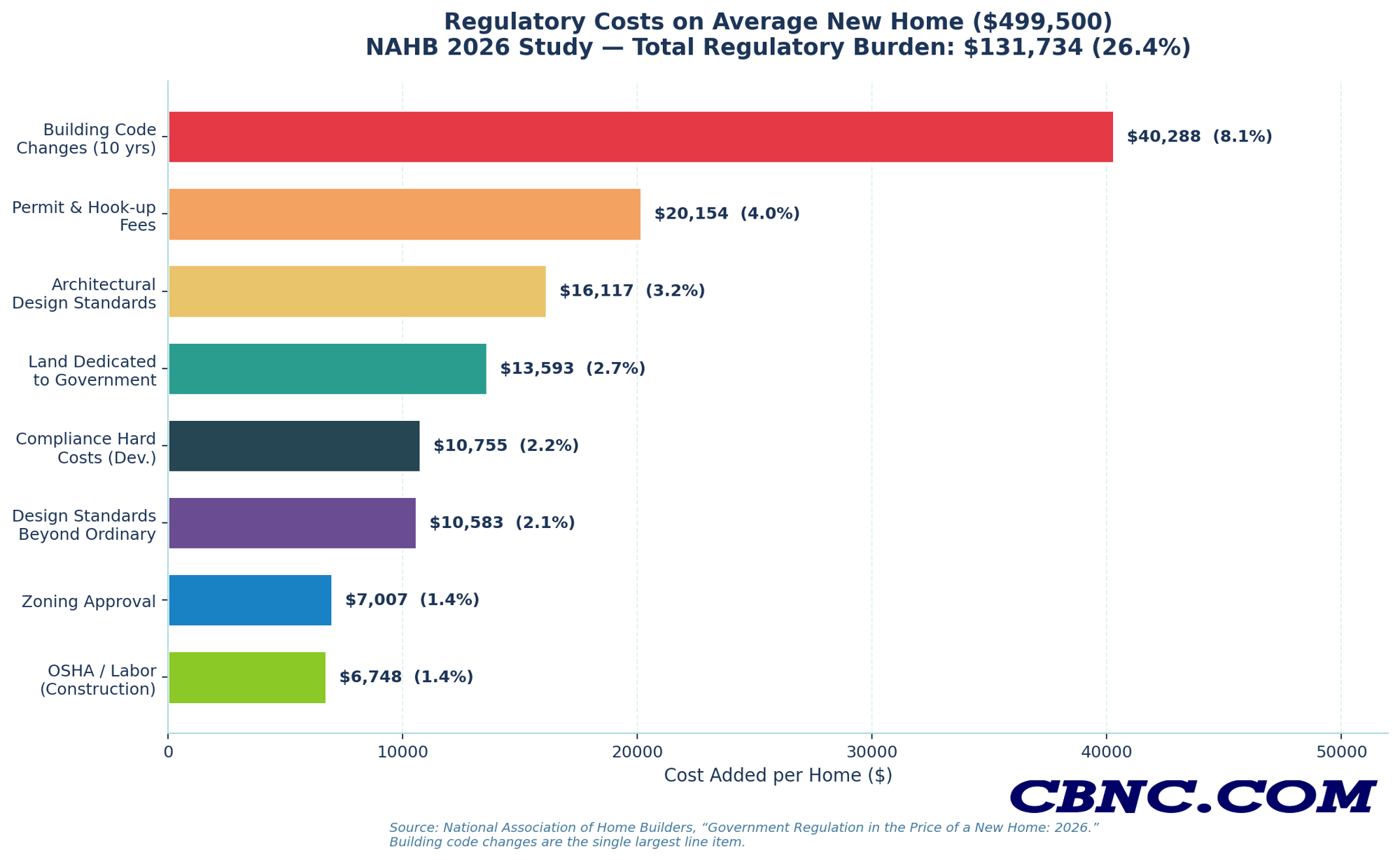
One hundred thirty-one thousand, seven hundred thirty-four dollars. That is what federal, state, and local regulation now stacks onto the average new single-family home before a family ever gets the keys. National Association of Home Builders put the figure at 26.4 percent of a $499,500 average new-home price. Building-code changes alone take more than $40,000. Who pays? The first-time buyer. The builder who still shows up with a crew. The renter trying to climb into ownership. This is America.
Name the moral hazard. Washington can celebrate executive orders, task forces, and manufactured-housing pilots while the code-and-fee stack still extracts $131,734 on the way to closing. That is how you promote bad behavior. You sell a press conference as a rescue. The people who carry their own water still write the check.
Just the News, reporting Amanda Head’s October 22–23 update on President Trump’s housing executive order, locked the NAHB math in plain English: total regulatory costs at $131,734, or 26.4 percent of the average new single-family price as of early 2026, with building-code changes alone adding over $40,000. The same piece carried the April 2026 Economic Report of the President estimate of a roughly 10-million-unit single-family shortfall relative to pre-2008 construction rates. That report blamed a Biden-era cocktail that boosted demand while constraining supply — green building-code mandates, “equity plan” rules, and local regulatory costs already estimated at more than $100,000 per new home. Independent NAHB surveys finished the ledger. The June 2026 special study, based on March surveys of developers and builders, applied Census’s January average sales price and got $131,734. Development-phase regulation: $46,795. Construction-phase regulation: $84,939. Code changes over the past decade: $40,288 — the single largest line, more than twice any other category.
Forty percent. That is how much the regulatory dollar load climbed from the 2021 estimate of $93,870. The Advocate’s November 5 Baton Rouge business desk heard the same NAHB forecast language on the ground: roughly $132,000 per new home, about a quarter of cost, up 40 percent in five years, with single-family building expected to fall about 4 percent by year-end. Debt is not free. A family that saves a down payment does not get a rebate because a zoning board needed another study or a model code got another green ratchet. Subsidize delay with other people’s monthly payment and you teach the next generation that paperwork is destiny.
Now look at the multifamily tape. The Epoch Times, updating November 4–5 from a RentCafe / Yardi Matrix read across 369 metro areas, reported new apartment units expected to open in 2026 at 442,395 — down 27 percent from 605,768 last year and below the roughly 466,000 ten-year average for the first time in four years. NAHB’s October 20 analysis, cited in that same Epoch package, showed multifamily starts — apartments and condos — down 24.9 percent year over year in September. Chairman Bill Owens did not hedge the causes: high mortgage rates, persistent affordability challenges, rising construction costs, and the need to ease regulatory barriers. Rates are context. They are not the core. Yesterday’s payment story already ran the locked-out buyer at 7.18 percent. Today’s stake is the rule stack that prices supply out before the loan even prices the month.
Who builds anyway? The South is still expected to supply 47 percent of the new apartments this year — about 208,085 units — with Florida and Texas leading. RentCafe pointed to population growth, developable land, and less restrictive regulations. The West and the Northeast tell a different cost story. That split is the America First map in construction form. Where the rulebook is lighter, crews pour. Where the rulebook is a second mortgage, starts shrink. Promote the bad behavior of treating every new mandate as free safety theater and you get fewer roofs for the people who punch a clock.
Local government is not a bystander. Atlanta City Council voted 10-4 on November 3–4 framing to raise downtown transportation impact fees for large commercial towers. City planning staff put a 500,000-square-foot office project at about $2.4 million under the new schedule versus roughly $1.5 million before — nearly $900,000 more at permitting — with $8 million to $12 million in annual collections forecast once projects hit the pipeline. Mayor Andre Dickens sold infrastructure. Opponents, including Council member Matt Westmoreland, warned competitiveness while Atlanta’s office market stays unsettled and hybrid work still empties towers. Attribute the boast about sidewalks and MARTA links. Then state the American cost. Every extra fee line gets tested against rents, construction pricing, and the cost of capital. When the office book is already soft, the fee does not land on a spreadsheet villain. It lands on projects that do not pencil and on workers who never get the job those projects would have hired.
Trump’s October 22 order points the right direction for carriers: an FHFA pilot to auto-cancel private mortgage insurance once equity thresholds clear, a permanent title-insurance waiver track to cut refinance friction, a Task Force on Manufactured Housing Innovation co-chaired by HUD and FHFA, and follow-through on the ROAD to Housing chassis rule and HUD’s Next Generation manufactured-housing plan. Manufactured homes have averaged around $135,000 in recent Census reads — a fraction of site-built sticker. Institutional-buyer limits and Opportunity Zone permanence are part of the same supply-and-demand fight. Direction is not delivery while the regulatory stack still takes $131,734 off the top of a site-built sale. Do not confuse a task force with a finished lot. Do not confuse a pilot with a key in the door.
This is America. People who carry their own water do not need another victory lap over process while apartment deliveries fall below the decade average and every new stick-built home eats a six-figure rule tax. They need permits that move. They need codes that protect life without pricing the starter buyer out. They need cities that stop treating impact fees as a second business model when commercial vacancy is already high. The next generation watches a 10-million-unit shortfall argument in the Economic Report, a $131,734 NAHB stack on the average new home, a 27 percent plunge in expected apartment openings, and a 24.9 percent dive in September multifamily starts. Then they get told the Dream is a branding exercise.
Defend the carriers. A dual-income household locked out by a payment that already includes the code tax is not failing personal responsibility. A small builder staring at $40,288 in decade-long code creep before the first rough inspection is not greedy. The moral hazard sits with anyone who sells EO headlines as mission accomplished while federal green and equity mandates, state adoptions, and local fees still compound into more than a quarter of the finished price. Heat stays on. Supply is the stake. Families who carry their own water get roofs when the rule stack shrinks — not when the podium gets another plaque.
America First housing means lower carrying costs for people who work, save, and refuse the bailout habit. NAHB’s $131,734 regulatory load, the Economic Report’s roughly 10-million-unit single-family shortfall frame, Epoch’s 442,395 apartment units expected in 2026 — 27 percent below last year and under the ten-year average — and Atlanta’s fresh multimillion-dollar downtown fee hike all say the same thing in floor language: the people who pay for the Dream are still paying for the paperwork. Say it straight. Then keep the heat on until the cost comes out of the house, not out of the family’s future.
Sources:
- https://justthenews.com/government/white-house/housing
- https://www.theepochtimes.com/business/us-apartment-builds-drop-below-10-year-average-for-first-time-in-4-years-6117662
- https://www.nahb.org/-/media/NAHB/news-and-economics/docs/housing-economics-plus/special-studies/2026/special-study-government-regulation-in-the-price-of-a-home-june-2026-updated.pdf
- https://www.foxbusiness.com/economy/government-regulations-add-132k-new-home-costs
- https://www.theadvocate.com/baton_rouge/news/business/housing-affordability-struggles-regulatory-costs/article_1bae4b2e-a2b7-450d-a54d-ef40a8eb59ef.html
- https://abjdigital.com/ArticleDetail?slug=atlanta-council-approves-new-fees-for-downtown-commercial-towers-1793832117599
- https://www.housingwire.com/articles/code-changes-regulatory-costs/
Visuals:
- Callout graphic: $131,734 regulatory cost = 26.4% of $499,500 avg new home; building codes $40,288 largest line
- Bar chart: expected 2026 apartment openings 442,395 vs 605,768 prior year vs ~466,000 10-year average (RentCafe/Yardi)
- Secondary panel: Atlanta downtown impact fee ~$2.4M vs ~$1.5M for 500k sqft office (Council 10-4)