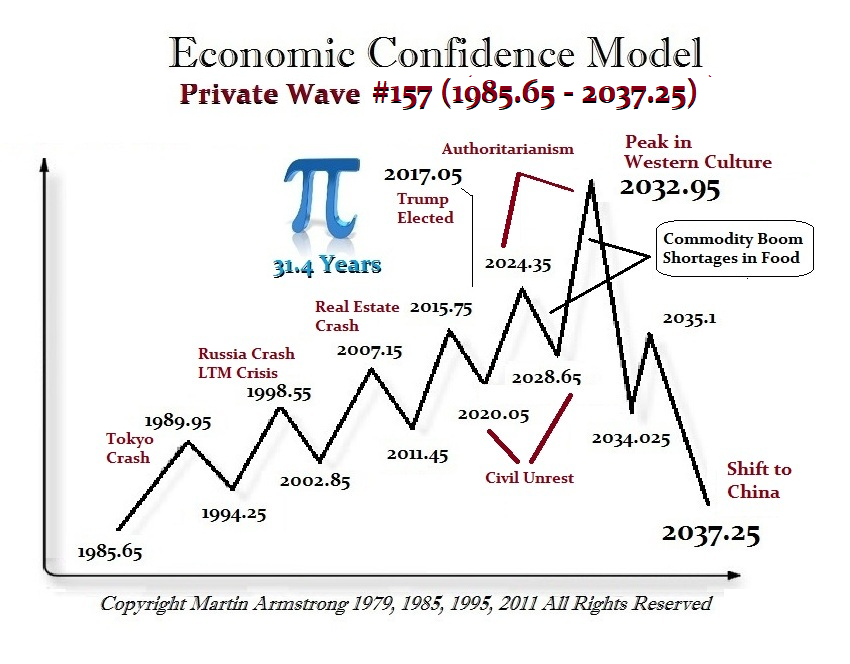
The Centre for Strategic and International Studies determined that the definition of a civil war is a conflict in which at least 1,000 people are killed. The institution likened the definition to the 1791 Whiskey Rebellion that broke out due to excessive taxation, and believes the US is on the brink of another civil war.
The first wave of the ECM following the 1776 revolution bottomed in 1784, the postwar adjustment phase, when the economy stabilized after independence. From there, the cycle advanced toward the 1792 peak, marking the first wave of rising confidence in the new system. That peak corresponded with Alexander Hamilton’s fiscal consolidation, the creation of the Bank of the United States, and of course, the excise tax on whiskey.
By 1794, as the ECM turned down into the 1798.6 low, we witnessed the collapse in localized confidence manifest as rebellion. Washington…