

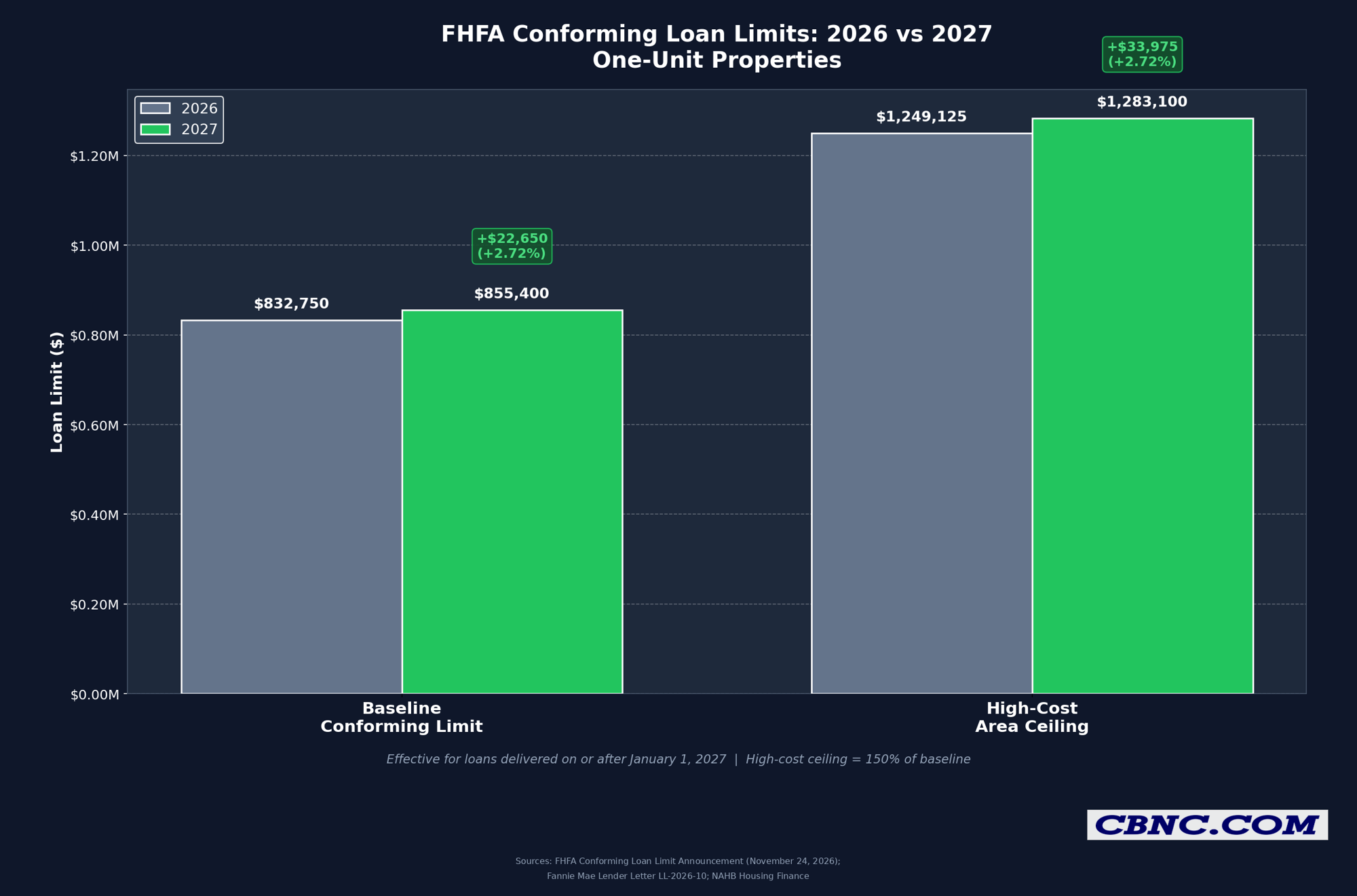
$855,400. That is the new ceiling on a mortgage Fannie Mae and Freddie Mac can buy in most of America next year. Up $22,650. In the pricey markets it is $1,283,100. One point two eight million dollars, backed by two companies the government has run since the 2008 bailout. So who pays if it goes wrong? You do. The taxpayer. The guy renting a two-bedroom in Ohio who will never see a loan that size.
This is America. You carry your own water. But this program keeps raising the size of the bucket for people who want to drink from the federal well. That is moral hazard, and it is written into law.
THE NUMBER
The Federal Housing Finance Agency announced the 2027 conforming loan limit Tuesday. In most of the country, one-unit homes get a $855,400 cap, up from $832,750, according to the agency. The high-cost ceiling rises to $1,283,100 from $1,249,125, according to the National Association of Home Builders. In Alaska, Hawaii, Guam and the U.S. Virgin Islands, the baseline is $1,283,100 and the ceiling is $1,924,650. The cap goes up in all but 24 U.S. counties.
The formula is automatic. The Housing and Economic Recovery Act of 2008 ties the limit to FHFA's house price index, which rose 2.72% between the third quarters of 2025 and 2026. And here is the kicker, as HousingWire reports: the law stops the limit from falling when prices fall. It only goes up. A ratchet. Washington built a one-way door.
WHO PAYS
Look at what a normal house costs. HousingWire Data put the median list price of a single-family home at $425,000 for the week ending Nov. 20. The new baseline limit is about twice that. A loan more than double the median price still rides the government-backed lane.
Fannie and Freddie have been in conservatorship for 18 years, according to Realtor.com. Treasury has collected nearly all their profits, more than $300 billion, which exceeds what the government put in during the bailout. Fair enough. Say it straight. But a conservatorship is an implicit guarantee, as former FHA Commissioner Frank Cassidy told Realtor.com. Implicit means the taxpayer stands behind it without ever voting on it. FHFA says the enterprises it regulates, together with the Federal Home Loan Banks, provide more than $8.7 trillion in funding to the mortgage market. Debt is not free. The next generation gets the bill if the next crash comes.
And the lenders saw it coming. Rocket Mortgage lifted its own conforming limit to $845,000 in September, HousingWire reports. Pennymac set $850,000. They front-ran the government because the government guarantee is the product.
THE MARKET IT LANDS ON
This is landing in a cold market. The S&P Cotality Case-Shiller national index rose just 2.1% in September from a year earlier while consumer prices rose 3.7%. That is the 16th straight month that home values fell after inflation, according to Realtor.com. The median existing-home price rose only 0.4% from a year earlier in October. Months' supply hit the highest since 2015. And 30-year mortgage rates are back above 7%.
So prices are flat, rates are above 7%, and Washington's answer is to let more of the biggest loans ride the federal guarantee. That does not make a $425,000 house cheaper for a young family. It makes the $1.2 million house easier to finance for a buyer who already has the down payment.
THE BOTTOM LINE
Do not subsidize the people who drink the water. Reward the people who carry it. The renter saving for a starter home, the family that bought what it could afford, the small-town borrower with a $250,000 loan. They pay their bills. They should not be the backstop for a million-dollar mortgage in a coastal county. Treasury Secretary Scott Bessent has said the question of ending the conservatorship could come up again in 2027 or 2028, according to Realtor.com. Until then, the limit climbs, the risk grows, and the taxpayer holds the bag. Moral hazard is the point. Name it.
Sources
- https://www.fhfa.gov/news/news-release/fhfa-announces-conforming-loan-limit-for-2027
- https://www.housingwire.com/articles/fhfa-raises-2027-conforming-loan-limit-855400/
- https://www.nahb.org/blog/2026/11/conforming-loan-limits
- https://www.realtor.com/news/real-estate-news/fannie-mae-freddie-mac-conservatorship-midterm-election-2026/
- https://www.housingwire.com/articles/case-shiller-inflation-home-prices/
- https://www.realtor.com/research/case-shiller-home-prices-september-2026/