
By Laurence Rodin CBNC Business News
Anthropic, PBC raised $81.3 billion from public investors on Wednesday, selling 980 million Class A shares at $83 each in the largest initial public offering on record, and the capital those investors supplied carries almost no power to discipline how it is spent. Under the company’s charter, a single share of Class F stock held by a vehicle owned by its seven co-founders commands 50.1% of all shareholder votes, while a separate trust elects a majority of the board. For American capital markets, the consequence is plain: the largest pool of equity ever raised in one offering has been allocated to an enterprise in which capital providers cannot change management.
THE INSTITUTION AND THE MECHANISM
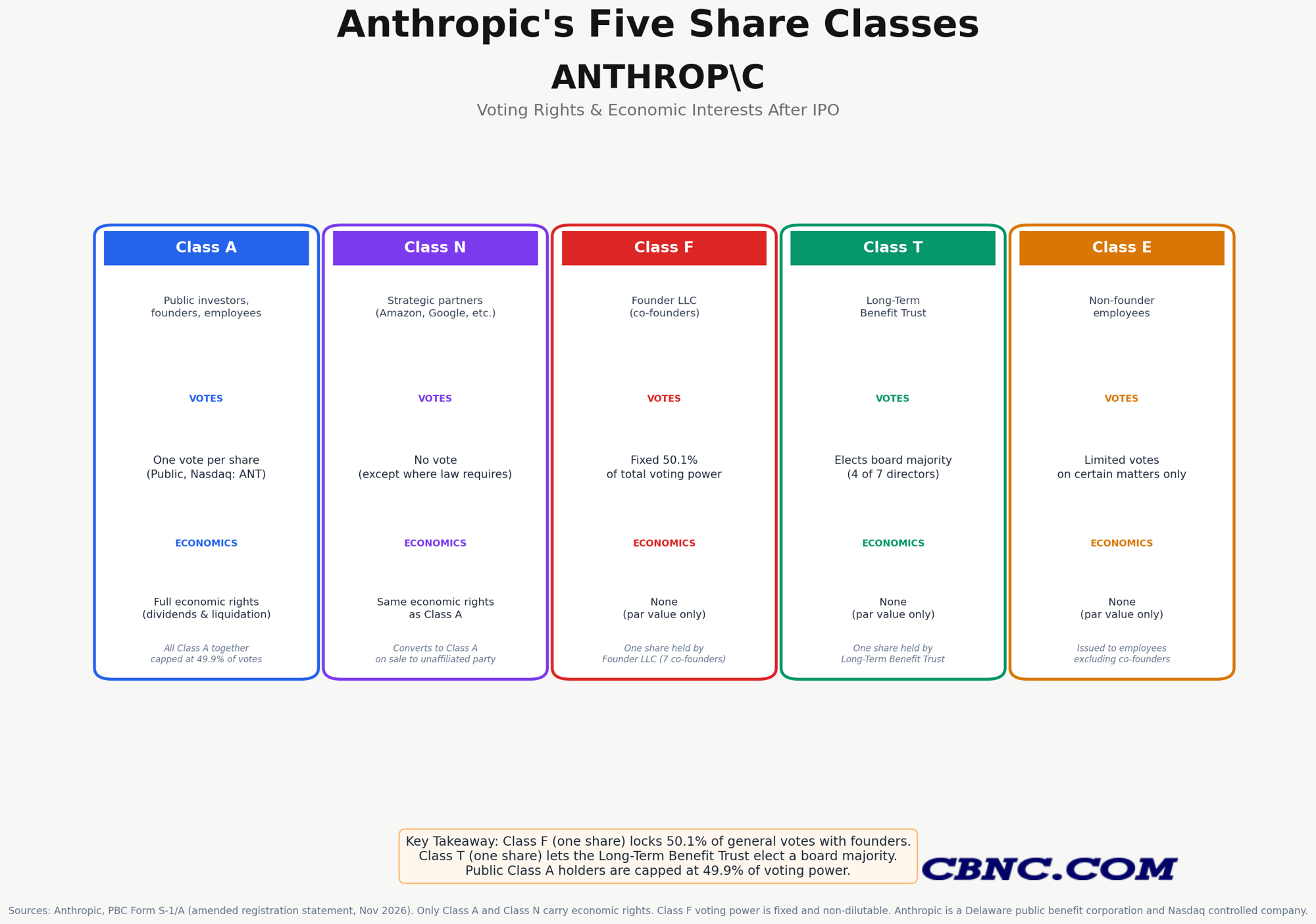
Anthropic’s registration statement with the Securities and Exchange Commission describes five classes of common stock. Class A, the class sold to the public, carries one vote per share. Class N, held primarily by strategic partners, carries none. Class F, a single share issued to the co-founders’ “Founder LLC” immediately before the offering, has no economic rights but carries 50.1% of total voting power on matters put to shareholders, including the election of every director the trust does not appoint. Class T, a single share held by the company’s Long-Term Benefit Trust, elects the Class T directors, who constitute a majority of the board; Investopedia’s reading of the filing puts that at four of seven seats. The filing states that the founders’ combined voting power, including their ordinary holdings, is expected to reach 61.3%, and that the structure gives them “the ability to determine the outcome of all matters submitted to a vote of our stockholders generally for the foreseeable future.”
Anthropic is therefore a “controlled company” under Nasdaq rules, a designation that relaxes certain board-independence requirements. It is also a public benefit corporation, a Delaware form that obliges directors to balance shareholders’ financial interests against a stated public purpose. In plain terms, management is legally permitted to weigh something other than return on capital, and investors have surrendered the vote that would otherwise check that discretion.
HOW THE COST TRANSMITS
The pivot is this: governance is not a matter of etiquette; it is the mechanism by which capital is reallocated when management errs. Strip out the vote, and the only remaining discipline is the share price itself, which is a far blunter instrument.
The scale of what is being governed makes the point sharper. The prospectus reports $33.24 billion of revenue for the nine months ended Sept. 30, up about 1,200%, against a net loss of $104 billion for the same period. Roughly $94.3 billion of that loss reflects changes in the fair value of convertible notes, derivatives and SAFEs, which still leaves roughly $9.7 billion of loss before those accounting marks. The company has also committed to spend up to $120.5 billion on SpaceX computing capacity through 2029, about $3.1 billion a month once all capacity is delivered. Those are capital-formation decisions on the scale of a mid-sized national budget, and they will be made by a board that public owners cannot replace.
The offering also redirected capital already in the market. Argent Capital’s Jed Ellerbroek observed on Thursday that “that money is coming from somewhere,” as funds sold other holdings to make room for the new listing. The shares closed their first session at $97.17, up 17% from the offering price, after opening at $111.50. A fully diluted value near $1.75 trillion was assigned to a five-year-old enterprise in a single afternoon. In past cycles, record-size offerings have often arrived late in a confidence cycle, when capital is most willing to accept weak terms; June’s SpaceX listing and this week’s Anthropic offering now sit back to back at the top of the league table.
THE CONSEQUENCE FOR AMERICAN PRODUCTIVE CAPACITY
The United States needs frontier computing capacity, and private capital building it is preferable to Washington directing it. The concern is narrower and more durable. When the largest equity raise in history carries the weakest owner rights, the market sets a precedent that discipline is optional for the most capital-intensive firms in the economy. Data centers, power contracts and chip commitments are long-lived physical assets. If they are misallocated, the error is embedded in the American productive base for a decade, and shareholders have no lawful means short of selling to correct it.
Dario Amodei said on Thursday that the company hopes to earn an investment-grade credit rating and that “debt is an instrument that we have available to us.” Bondholders, unlike Class A shareholders, write covenants. It may prove to be the creditors, not the owners, who end up supplying the governance this structure omits.
This analysis is for educational purposes only and does not constitute investment advice.
Sources:
sec.gov/Archives/edgar/data/2130357/000162828026074338/anthropicpbc-sx1ax3.htm
anthropic.com/news/anthropic-prices-initial-public-offering
cnbc.com/2026/11/19/anthropic-ipo-ant-live-updates.html
investopedia.com/who-will-control-anthropic-after-its-ipo-key-details-in-the-ai-giant-s-filing-ant-stock-12195513
streetinsider.com/Reuters/Wall+Street+ends+sharply+lower+as%C2%A0Anthropics+debut+fails+to+revive+AI+fervor/27376046.html