Photo – ICE_Charleston_Enforcement_Op PDo
By Jennifer Sanchez CBNC News
Connecticut cannot enforce its ban on masked federal immigration agents or its scheme to investigate and prosecute them, U.S. District Judge Vernon D. Oliver, appointed by President Joe Biden, ruled Friday, holding that four sections of the state’s new law likely violate the Supremacy Clause of the U.S. Constitution.
The order is a preliminary injunction, not a final judgment. It bars Gov. Ned Lamont, Chief State’s Attorney Patrick Griffin, and the state from enforcing the challenged provisions against federal officers, agents, and employees. It separately bars state Inspector General Eliot Prescott from enforcing several of the use-of-force sections. The provisions remain in effect as applied to state and local officers.
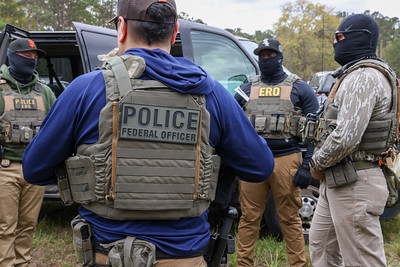
The law at issue is Public Act 26-14, which Connecticut enacted in May. It extended the state’s use-of-force standards to federal law enforcement, authorized the inspector general to investigate deadly force by federal agents and, where he saw fit, prosecute them, and required federal officials to give his office access to crime scenes. A fourth section barred officers, including federal agents, from wearing face coverings while dealing with the public, outside narrow exceptions, and required them to display a badge and name tag during planned arrests and public encounters. Violations of the mask and identification rules were misdemeanors, and the law took effect immediately.
The Justice Department sued on May 15, within days of the law’s passage, arguing that a state has no authority to set conditions on federal officers carrying out federal law. The case was first assigned to U.S. District Judge Sarala V. Nagala, appointed by President Joe Biden, and was reassigned to Oliver in July.
In a ruling of nearly 40 pages, Oliver sided with the federal government. He found that the challenged sections allow Connecticut to regulate federal officers performing federal duties, which the Supremacy Clause does not permit. He also found that the threat of state prosecution could interfere with federal operations and create safety risks for officers and their families, the same concern immigration officials have raised about doxxing and targeting of agents who make arrests in hostile jurisdictions. Oliver quoted the Federalist Papers on the need for a national government that is not bound by state law.
The court did not hand federal agents a blank check. Oliver wrote that federal officers do not hold blanket immunity from state prosecution, and that immunity turns on whether an officer acted within federal authority and did no more than was necessary and proper. That is the standard the Supreme Court has applied for more than a century, and it leaves Connecticut with the ordinary tools any state has when an officer steps outside the law.
Attorney General William Tong was dismissed from the case. The court found that he lacked authority to enforce the challenged provisions.
The holding matters beyond Hartford. Several Democrat-led states have passed or proposed similar mask bans and identification mandates aimed at Immigration and Customs Enforcement. Friday’s ruling is a federal court’s direct statement that a state legislature cannot criminalize the way federal agents equip and identify themselves while enforcing federal immigration law.
The source of the ruling is the point. A judge appointed by President Biden, reviewing a law passed by a Democrat legislature and signed by a Democrat governor, found that it likely could not survive the Constitution. Connecticut may appeal to the U.S. Court of Appeals for the Second Circuit. Until then, the state’s federal-agent provisions are on hold.
Sources:
wfsb.com/2026/11/20/federal-judge-temporarily-blocks-parts-connecticuts-ice-restrictions
ctpost.com/news/article/ct-ice-mask-ban-judge-decision-22541829.php
connecticut.news12.com/federal-judge-blocks-connecticuts-sweeping-new-law-restricting-ice-agents
clearinghouse.net/case/48432
ctd.uscourts.gov/biography-district-judge-vernon-d-oliver