Photo – Rawpixel.com/Shutterstock
By Zorina Grey CBNC News
American naval escorts have pushed Gulf oil exports back above 80 percent of their pre-war level, and Iran answered this week by attacking the navigation equipment on Didamar, a small Omani island in the Strait of Hormuz that Tehran accuses of guiding tankers under American protection. Three sources with knowledge of the matter confirmed the attack to Reuters on Wednesday, November 11, 2026, a day after Iranian state media claimed that the Islamic Revolutionary Guard Corps had destroyed “enemy navigation systems” on the island.
Didamar is a slab of rock about 10 nautical miles north of the tip of Oman’s Musandam peninsula. In peacetime it hosts the Hormuz Control Centre, staffed by the Royal Navy of Oman, which manages traffic through the shipping lanes of the strait. The island carries a lighthouse, a radio relay tower for maritime communications, and a marine radar on a 25-meter mast, according to The Maritime Executive. Tehran said the personnel there “were helping the flow of oil smuggling by the enemy.” Omani officials confirmed that a loud explosion was detected. A senior Omani official told The Maritime Executive that the navigation aids were not struck, and satellite imagery from the morning of November 10 showed no obvious damage to the masts. Reuters could not determine whether any equipment was destroyed, and two shipping sources said the effect on commercial traffic would likely be limited because other systems are in place.
The attack on Didamar came alongside a run of Iranian claims at sea. Iran’s army said on Wednesday that a tanker struck a mine and caught fire in the eastern part of the strait, and the Revolutionary Guard said two more tankers hit mines while sailing, in its words, “under the protection of fighter jets” belonging to the U.S. military. A projectile struck the Liberia-flagged supertanker Fujairah Energy in the Gulf on November 10 and injured four crew members, according to Gulf News. The United Nations’ International Maritime Organization has counted at least 130 confirmed incidents in these waters since the war began, with at least 25 seafarers killed, and October was the worst month on record.
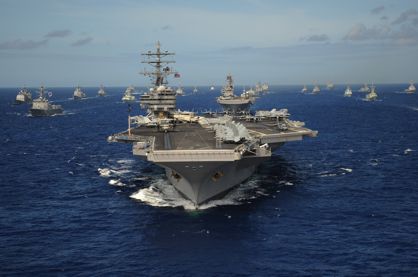
The strategic objective of the American escort mission is to keep the world’s most important oil corridor open on terms set by the United States rather than by the Revolutionary Guard. The alternative left in place is a strait in which Iran decides which ships pass. That arrangement is not hypothetical. Iran has insisted since February that vessels use only routes it authorizes, and it continues to attack ships that do not.
The collectivist claim, repeated in Tehran this week, is that the strait can be made safe through regional consensus among the states that border it, and that American escorts are the provocation. Iranian President Masoud Pezeshkian accused the United States of conducting diplomacy through threats. Parliament Speaker Mohammad Bagher Ghalibaf, Tehran’s lead negotiator, said the ball is in Washington’s court.
The claim fails on its own facts. Oman is the most neutral state on the waterway. It neither blocks nor assists passage, and its navy rescues mariners from ships Iran has disabled. Iran attacked Omani territory anyway, adding Didamar to earlier Revolutionary Guard strikes on Omani ports at Duqm and Salalah. A consensus that includes a party willing to strike the neutral member offers no security to anyone. The capacity that restored the oil flow is American. Reuters reported that Gulf exports recovered to more than 80 percent of pre-war levels in September and October, aided by U.S. military-assisted transits and higher Saudi exports through the Red Sea port of Yanbu.
Iran’s incentive is equally plain. Security chief Mohsen Rezaei told Al Mayadeen that Iran would strike American bases as far away as Europe if aircraft from them were used against Iran, and the head of Iran’s Supreme National Security Council said Tehran would not surrender “a single particle” of its enriched nuclear material. Defense Secretary Pete Hegseth said on Tuesday that U.S. forces struck 13,000 targets over 40 days of combat. The United States carried out what President Donald Trump called “minor” strikes on Iran’s Qeshm Island last week and knocked out an air-defense system.
The contradiction is plain. Iran describes American escorts as the threat to the strait, and then attacks a neutral lighthouse because those escorts are getting the oil through.
Sources
https://www.straitstimes.com/world/middle-east/iran-attacks-shipping-navigation-systems-on-omans-didamar-island-sources-say
https://justthenews.com/government/security/iran-strikes-omani-island-allegedly-helps-ships-travel-through-strait-hormuz
https://maritime-executive.com/article/uncertainty-surrounds-possible-attack-on-oman-s-strait-of-hormuz-lighthouse
https://nypost.com/2026/11/10/world-news/iran-strikes-omani-island-accused-of-helping-ships-sail-through-hormuz/
https://www.cbsnews.com/live-updates/iran-war-us-nuclear-strait-of-hormuz/
https://gulfnews.com/world/mena/middle-east-conflict-iran-says-tanker-hits-mine-in-strait-of-hormuz-as-pezeshkian-criticises-us-1.500743246