By Jennifer Sanchez CBNC News
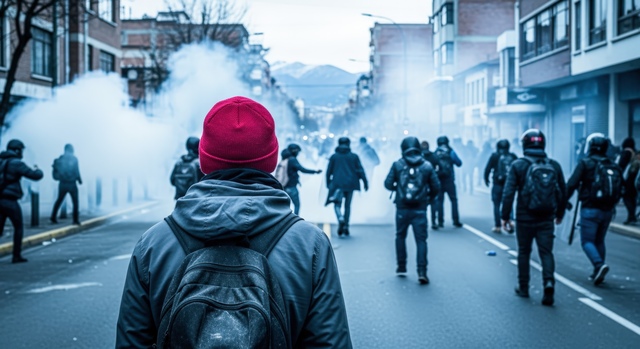
U.S. Circuit Judge Eric C. Tung, appointed by President Donald Trump, held for a divided Ninth Circuit panel on Tuesday, November 10, 2026, that residents of an apartment complex across from the U.S. Immigration and Customs Enforcement building in Portland, Oregon, have no substantive-due-process right to be free from tear gas that federal officers use to disperse disruptive crowds, and the panel vacated the preliminary injunction that had restricted its use. In a companion ruling the same day, U.S. Circuit Judge Kenneth K. Lee, also appointed by President Trump, wrote that “law enforcement agents may use nonlethal force to clear crowds and restore order,” and that “they need not wait until they face ‘an imminent threat of physical harm.'”
The first case is Reach Community Development v. U.S. Department of Homeland Security, No. 26-1575, on appeal from U.S. District Judge Amy M. Baggio, appointed by President Joe Biden. The plaintiffs are tenants and the owner of Gray’s Landing, a 209-unit affordable-housing complex near the ICE facility in the South Waterfront neighborhood. On March 6, Baggio ordered federal officers to stop using tear gas that could drift into the complex unless they faced an imminent deadly threat, finding “deliberate indifference” and a violation of the residents’ right to “bodily integrity.” The Ninth Circuit stayed that order pending appeal and heard argument on July 10 in Pasadena.
Tung’s opinion applies the test from Washington v. Glucksberg and Dobbs v. Jackson Women’s Health Organization. A right not written in the Constitution must be deeply rooted in the nation’s history and tradition. The court found no historical prohibition on nonlethal crowd-control devices and noted that such devices “have long been a common tool of law enforcement to disperse crowds that have turned disruptive and violent.” It found no federal or state court that had recognized the right the residents claimed.
The panel also rejected a new argument raised for the first time on appeal, that conduct which “shocks the conscience” is enough without any historical showing. Tung wrote that such a test, untethered from history, “is an open invitation for courts to make up law—one judge’s expectation is another judge’s shock.” He added that the plaintiffs’ theory would turn the Constitution into “a font of tort law.”
The second case was brought by protesters and independent journalists represented by the American Civil Liberties Union of Oregon. On March 9, U.S. District Judge Michael H. Simon, appointed by President Barack Obama, found that DHS operated under an “unwritten policy” of excessive force and restricted officers’ use of crowd-control weapons. Lee’s majority opinion found that the record did not show retaliation for protected speech. He wrote that the record instead reveals “law enforcement’s response to a substantial degree of violence, obstruction of law enforcement, and unrest — with protesters repeatedly trespassing onto the ICE facility, blockading the facility’s gates, vandalizing federal property, and attacking federal officers.” He described the plaintiffs as “unfortunate collateral casualties” of efforts to control “an unruly and sometimes violent crowd.”
According to Courthouse News, at least 150 protests took place at the Portland ICE facility between June 2025 and February 2026, some drawing several thousand people.
Scorecard — the judge who voted against the America First side in both cases: U.S. Circuit Judge Ana de Alba (Biden appointee).
In the residents’ case, de Alba would have applied the shocks-the-conscience standard alone and upheld Baggio’s finding. She wrote that the government’s “apparent deployment of chemical munitions for the purpose of social media content creation is particularly shocking.” In the protesters’ case, she agreed that three of Simon’s restrictions were too broad but would have kept his ban on firing munitions at a person’s head, neck, or torso unless deadly force was justified.
Skye Perryman, president of Democracy Forward, which represents the residents, said the decision “leaves Gray’s Landing residents without the protections they sought.” Kelly Simon, legal director of the ACLU of Oregon, said the group is “exploring all options.” The rulings end both injunctions but do not end either lawsuit, which may continue in district court.
The practical effect is that federal officers guarding the Portland ICE building are no longer bound by either district court’s limits on tear gas or other nonlethal munitions. Two Oregon district judges had drawn those limits, and two appellate judges have now erased them on the ground that neither the Constitution nor the record supported them.
Sources
https://cdn.ca9.uscourts.gov/datastore/opinions/2026/11/10/26-1575.pdf
https://www.courthousenews.com/ninth-circuit-clears-feds-to-use-tear-gas-at-portland-ice-facility/
https://www.oregonlive.com/crime/2026/11/2-judges-orders-limiting-feds-use-of-force-tear-gas-outside-portland-ice-building-thrown-out-on-appeal.html
https://www.opb.org/article/2026/11/10/appeals-court-overturn-pause-chemical-weapons-ice-portland/
https://www.fjc.gov/history/judges/baggio-amy-margaret
https://www.fjc.gov/history/judges/simon-michael-h