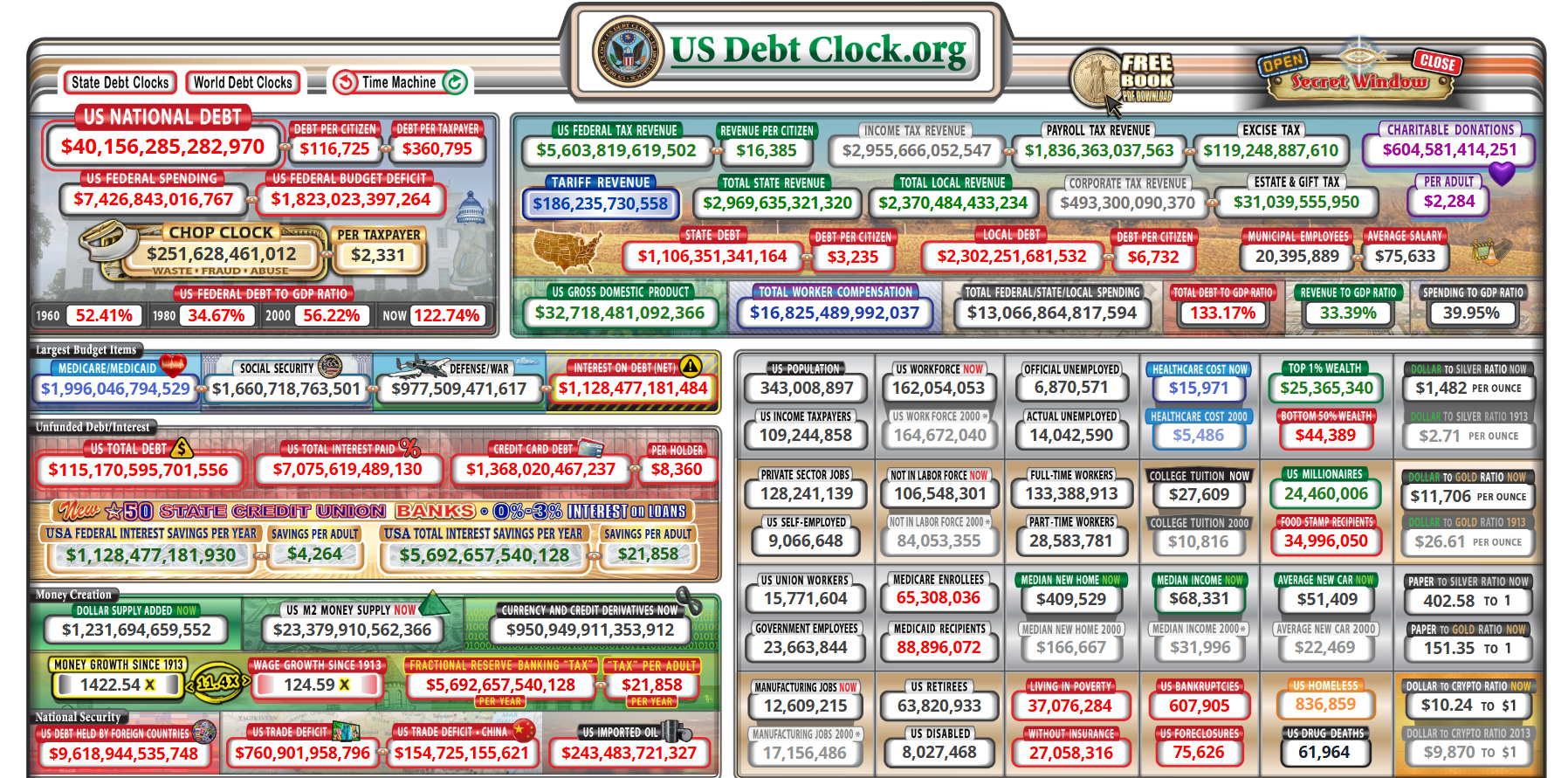
Photo Screenshot of the US Debt Clock.org
(Editors Note – This is a follow up to Buzzocles’ Comprehensive Analysis of Commodity Prices and the Economy. Link below JT)
Date: September 14, 2026
Prefix: The Commodity Conflation Fallacy
True market pricing is never the product of an isolated metric. To view silver purely through the lens of COMEX draw downs is a fundamental analytical error. Commodities operate within a synergistic matrix of geopolitical friction, monetary debasement, and physical constraints. The depletion of the Strategic Petroleum Reserve (SPR) will with other factors stimulate cost-push inflation into an economy already suffocating under a $40+ trillion sovereign debt wall. It is a wall because at this level the Federal Reserve has little recourse to its traditional monetary tools. Capital may flee to preserve value, seeking perhaps to transition to silver, but in this case it will collide with an inelastic industrial floor that cannot substitute its inputs. The resulting price rise will not be caused by one variable, but by the simultaneous confluence of many.
| Macro Variable | Current Magnitude (Sep 14-15, 2026) | Model Impact |
| Silver Spot Price | $63.66 / troy oz | Consolidating gains. Resting comfortably above primary mining costs, while remaining low enough to easily be absorbed by retail solar and electronics margins without triggering demand destruction. |
| COMEX Registered Float | 99.39M ounces | The 100M Ounce Resistance Wall. While inventory fluctuates daily due to active deliveries, warehouse inflows have slammed into a suspiciously constrained structural ceiling. The exchange is failing to rebuild its deliverable safety cushion above the 100M ounce threshold, leaving paper open interest heavily outnumbering physical metal. |
| U.S. Strategic Petroleum Reserve (SPR) | 286.6M barrels | Continuing to Approach Storage Minimum. Sits at its lowest level since 1982. The temporary price-suppression stopgap is running out of room, priming the cost-push inflation engine. |
| National Average Retail Diesel | $6.20 / Gallon | Structural Transport Shock. Rapid escalation past standard baselines, tracking active Red Sea/Hormuz supply disruptions and skyrocketing domestic distribution and mining haul costs. |
| Global Crude Benchmarks (Brent) | $107.68 / Barrel | Systemic Supply Failure. Brent breaking through the triple-digit threshold into a potentially parabolic run. |
| U.S. Sovereign Debt | $40.1 Trillion (and climbing) | The Sovereign Debt Trap. The interest-payment trap is shut tight. Real interest rates cannot be raised safely without threatening Treasury insolvency. |
| Geopolitical Proxy (The Gulf Shipping Crisis) | Absolute Disruption | Compounded by the complete physical closure of the Saudi East-West pipeline bypass network and active Houthi choke points at Bab el-Mandeb. |
Sunday Briefing Discussion
Q: If the math behind this multi-variable trap is so clear, why aren’t the world’s largest pools of capital aggressively front-running the physical delivery market right now?
The divergence comes down to a deep psychological split in how wealth is acquired and managed. There is a profound difference between the self-made multimillionaires who built fortunes “from the dirt” and the inherited or institutional elite. Entrepreneurs who have wrestled with raw materials, logistics, and real-world supply chains instinctively understand physical leverage and structural bottlenecks. When they look at a hollowing exchange vault colliding with a sovereign debt wall, their brains map it directly to real-world friction.
The Institutional Blind Spot
In contrast, institutional wealth managers and family offices are trapped in what psychologist Irving Janis famously defined as Groupthink. Janis contended that elite groups often make catastrophic blunders because they prioritize consensus and unanimity over a brutal, objective assessment of reality.
Wall Street’s proxy-hired “smart people” suffer from an illusion of invulnerability and collective rationalization. They comfortably ignore the paper-to-physical leverage ratio because their entire peer group is doing the same. For them, true career risk isn’t being wrong; it is being unconventionally wrong. If a fund manager buys standard assets and loses 15% alongside the rest of the market, they keep their job because everyone else lost money too. But if that same manager directs capital into physical silver vaults, and silver experiences a short-term 15% drop due to paper market volatility, they get fired immediately for speculative negligence. They would rather lose money safely within the herd than protect wealth brilliantly outside of it. They assume digital liquidity guarantees physical availability—a dangerous fallacy that will persist right up until the market breaks.
Q: Are we merely assuming the institutional elite are blind, or are they secretly front-running the physical market behind closed doors?
To resolve this, we must separate the highly visible institutional herd from the quiet actions of ultra-high-net-worth insiders. While public-facing institutional mandates force mainstream managers to preach consensus safety, a deeper inspection of global trade flows reveals that aggressive, masked front-running is already underway by a distinct class of capital. These large, private pools of wealth are actively securing physical positioning, but they are deliberately avoiding the public COMEX ticker to keep from triggering a price spike against themselves.
Evidence of this movement exists but it is conflated in the form of air freight anomalies, arbitrage plays, and other dynamics. We will discuss this in our next report. For now, let’s keep an eye on the aforementioned factors. s.